Contents Quick Links
Starting a student-alumni group
Order of the Bell Tower officially begins
OBT students host alumni at football bowl game
Future famous actress steals the show
OBT members hobnob with big wigs
Hosting the Chancellor's Box at ball games
OBT becomes well known on campus and nationally
Problems arise as some members are inactive
More students from out of state join OBT
OBT supports new alumni center, moves in
Extern Program starts off hot, burns out
The University's Bicentennial Observance
Policies change after concerns about drinking alcohol
OBT role changes as bond with GAA, seniors strengthens
Success of OBT reunions over the years mixed at best
Chancellor for a Day and Chancellor's Chase programs
Social Media and expansion of charity fundraising efforts
Shadow Day lets high schoolers experience college
OBT becomes keeper of UNC traditions as mission changes
Membership reduced as GAA takes on more responsibility
What happened to Obi, the OBT's hand puppet mascot?
Bell Tower events bring OBT closer to its namesake
The Bell Tower through the years
Copyright © 2017 CB3Media. All Rights Reserved.
________________________________________________________
How soft the music of those village bells
Falling at intervals upon the ear in cadence sweet ...
With easy force it opens all the cells where memory sleeps.
-- William Cowper, English poet
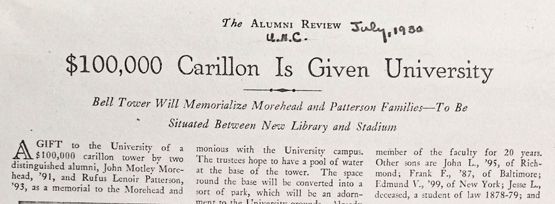
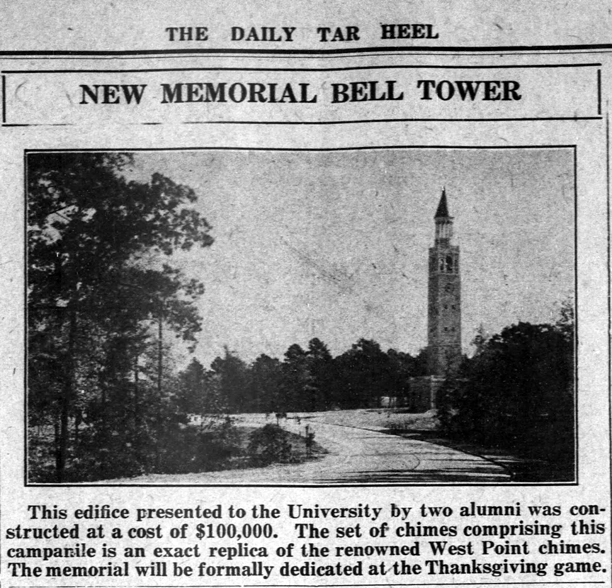
"And so the musical notes that will come to future generations from the chimes of this beautiful tower will at once bring back the past and inspire for the future," George Gordon Battle said at the dedication of the University of North Carolina's Bell Tower on Thanksgiving Day in 1931.
How right Battle - a prominent New York attorney and Rocky Mount, NC native who entered the University 50 years earlier at the age of 13 - turned out to be.
As he gazed at the top of the brand new 172-foot structure, listening to the reverberating sounds of "The Bells of St. Mary's," what he couldn't have known was that 50 years after the gift of the Morehead-Patterson Memorial Tower was announced, a student-alumni service organization named after the Bell Tower would be announced that would honor the memories and uphold the traditions of the University into the future.
But before the Order of the Bell Tower would be formed, the Depression would end; the second World War would start and end, as would the Korean Conflict; a president would be assassinated; and the Vietnam War and the Watergate scandal would split the country and the generations.
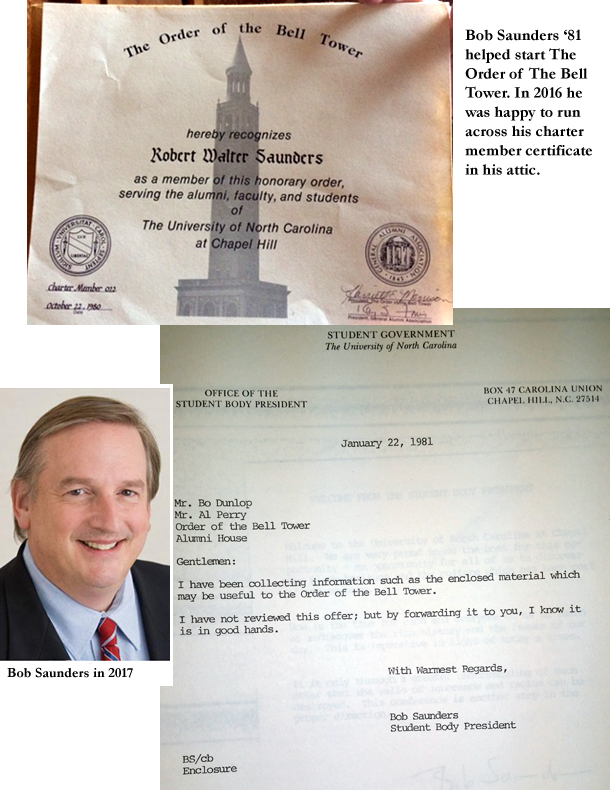
However, in 1980, Dr. Dewey Dorsett, a 1947 Carolina alumnus, would visit newly elected student body president Bob Saunders '82 in his on-campus office about starting a student-alumni group.
Dr. Dorsett, who was just coming off a term as president of the UNC General Alumni Association, was envious of a huge event at the University of Florida where a student alumni group sponsored a celebration in conjunction with the annual football game against rival Florida State called the Gator Growl.
He saw the enthusiasm and the important role the Gator Growl played in student life in Gainesville and how the students and alumni got along. But there wasn't a group in Chapel Hill dedicated to putting on such events and interacting with alums to show school spirit and school pride. And it was needed.
After all, the University of North Carolina was in the midst of a successful era in sports with great promise for the future. The UNC football team had upset the favored Michigan Wolverines in the Gator Bowl in December of 1979 and seemed set for more success with a linebacker named Lawrence Taylor. The return of senior Al Wood, along with a sophomore by the name of James Worthy, had Carolina fans salivating about the future of their perennial powerhouse basketball team.
In addition, the country and individual families had healed from Vietnam and Watergate. "It was the end of the '60s and '70s era and it was just a calmer time with better relations between kids and their parents, and students and alumni," Saunders, the 1980-81 UNC student body president, said.
A student-alumni group at Carolina was an idea whose time had come. "If you had tried this idea earlier, it would not have been as successful," Saunders said. "Maybe it was just pure luck or chance or serendipity that it was introduced at a time when students were interested and alumni were welcoming to have a relationship with students. It was the right idea at the right time."
There had been earlier efforts to bridge the gap between students and alumni.
For instance, in the 1920s prospective students in high school, along with college students from the county met with various North Carolina-based alumni groups at country clubs and other venues.
By 1926, a student-alumni banquet in Greensboro during Christmas vacation had become an annual event. The Randolph Club sponsored a meeting with UNC students from that county. At the meeting, the students formed a group with the intention on meeting once a year.
The Fayetteville club was the first to allow women students to attend. "With the advent of the ladies, making the clubs truly representative of all of the University students, it seems that this sort of club has become a Carolina institution," The Daily Tar Heel reported on March 13, 1926.
In the 1930s, "smokers" - which were similar to "mixers" of later years except with cigarettes provided by tobacco companies as the main attraction - were an avenue for faculty, students and, to a lesser extent, alumni to interact. With the University nearly 150 years old, the subject of tradition came up at a 1931 senior class smoker. Dr. George R. Coffman, the head of the English department spoke about the relationship between students, alumni and faculty.
Dr. Coffman talked about how each group could carry on the University's great traditions, which The Daily Tar Heel described as "indescribable." He said students can carry on the tradition by striving for higher levels in their activity and by "bearing the relationship to the University which a foster son bears to a foster mother."
He challenged the faculty to perpetuate the tradition "by maintaining higher standards in curriculum" and he asked that alumni carry on tradition by being loyal sons of the University.
In the 1940s, some looked to the success at Penn State "where students talk and mix freely at all alumni functions." Representatives of the UNC student body were invited to the annual Alumni Association dinner in 1941. The Daily Tar Heel reported that this "marked a new policy in Student-Alumni relations, that will undoubtedly lead to better understanding of student problems by alumni, and a better insight into the alumni viewpoint by the students."
While "smokers," as well as annual alumni dinners, continued into the early 1960s, the main way students and alumni interacted in the 1950s was through cocktail parties before and after football games. Many of those were sponsored by fraternities, who also kept up with alumni at award ceremonies and through newsletters.
There seems to have been very few, if any, new efforts to strengthen the student-alumni relationship during the turbulent 1960s.
But by 1972, the sophomore and senior class' External Affairs Committees recognized that there should be a "breaking of the barrier between students and alumni." They started the Student-Alumni Awareness Program (SAAP) aimed at informing students about "the Carolina way of life" and to help alumni gain a "greater understanding of the current Carolina student."
While that was the idea, in practicality the group focused mainly on high school seniors who had applied to Carolina. Students and alumni would meet with them in their hometowns or the high school student would come to UNC and "pal" around with SAAP members to give them an idea of college life in Chapel Hill.
Students and alumni did work together on the project that was funded by the Student Legislature and the UNC General Alumni Association. The hometown visits took place mostly in the homes of local alumni starting in Goldsboro followed by trips to Rockingham, Reidsville, Raleigh, Asheville, Durham, Kinston, Albemarle, Laurinburg and Salisbury.
There was one SAAP event out of state in Atlanta. The Durham event was attended by Clarence Whitefield, the GAA's executive secretary, and Bo Dunlap, the GAA's assistant director - both of whom would be instrumental in the birth of the Order of the Bell Tower eight years later.
Within two years of its beginnings, there was no further mention of SAAP.
In fact, none of the student-alumni efforts had the lasting affect and wide breadth of the Order of the Bell Tower.
"You start a lot of ideas on campus - sometimes they last and sometimes they don't," Saunders said explaining that some projects are seen as part of a particular year's administration rather than an ongoing University-supported activity.
Saunders, as student body president, and Lisa Goodwin '81, as senior class president, wanted the idea to go forward after they left Carolina so they looked at it as if they were spreading the seed on fertile soil but that others would tend to the tree and help it grown.
"Still, when we started this I don't think we had any idea it would last as long as it has," Saunders said, "much less, surviving and prospering while maintaining its general structure."
1930-31 Facts |
1980-81 Facts |
|
• The Morehead-Patterson Memorial Tower is planned, built and dedicated
. • The Tar Heels football team beats Virginia 13-6 on Thanksgiving, the day the Bell Tower is dedicated. • Future legendary UNC basketball coach Dean Smith is born. • It cost $100,000 to build Carolina's new Bell Tower. |
• The Order of the Bell Tower is planned, organized and officially recognized.
• The Tar Heels football team beats Duke 44-21 the week of Thanksgiving. • On Dean Smith's 50th birthday, the Carolina basketball team falls to Duke on a Gene Banks overtime shot. • It cost $22.3 million to build the Walter R. Davis library. |
When Dr. Dewey Dorsett '47 was president, the General Alumni Association had been looking for a way to help acquaint the Carolina student body with the GAA.
Today, in his 90s, Dr. Dorsett understandably doesn't remember the actual meeting with Saunders but he does remember pushing for such a group. "I thought it would be helpful to involve students in such a way that they could learn about the Alumni Association and be acquainted with it before they left," he said.
After the meeting with Dr. Dorsett, Saunders contacted Goodwin and the General Alumni Association. The GAA's Clarence Whitefield assigned Bo Dunlap to the project.
Saunders, Goodwin and Dunlap, along with other student government staffers, met several times to form the yet-to-be-named student-alumni group. They compiled information from other similar groups, most notably at the time the University of Florida and the University of Mississippi.
Goodwin, who had written speeches for Saunders' predecessor J.B. Kelly and coordinated a speakers bureau of students to talk to perspective UNC students, had already been invited to speak at alumni meetings and she knew the student-alumni group would go over well.
"The alums always enjoyed hearing about what the students liked to do," she said. "(I remember that) they hated hearing that the 'Shack' had closed but happy to hear that 'He's Not Here' had opened."
She remembers Dunlap coordinating a visit to a national conference at Clemson to help plan the student-alumni group.
Dr. Dorsett said it took a good professional staff with fertile imaginations and forethought to keep a group such as the Order of the Bell Tower going. "With students, you're there four years and you're gone but the pros are there year in and year out," he said.
Saunders agrees. "We got a lot of support and guidance from the GAA to steer the ship," he said. "If this had only been a student-led organization without the support of the GAA, it probably wouldn't even have gotten off the ground."
Once the idea was off the ground, there had to be a name. Few schools had a service group as envisioned. Some schools had groups formed specifically for an event - like Homecoming - and were named for that. Others, like Clemson, had ambassador-type programs primarily for showing people around campus and were named Alumni Ambassadors. And yet others had student groups much like a general alumni association and were called the Student Alumni Association.
The Florida Cicerones, at the University of Florida, is a student alumni association that also serves as ambassadors. The Florida Blue Key, formed in 1923, is the student-run group that produces the Gator Growl each year.
Similarly, UNC would need to choose a unique name.
For some time prior to the idea, those in student government - like Saunders, like Goodwin, like J.B. Kelly, like future president Scott Norberg - would sit around and joke about the secretive nature of the Order of the Golden Fleece, the Order of the Grail, the Order of the Old Well and others.
"Nobody really knew exactly what they did or what the criteria was for getting in," Saunders said with a laugh. "We thought wouldn't it be something to have an honorary to honor unsung heroes - folks who aren't known as leaders of a particular group but people who make the University work."
Guess what name they chose for the fictional group. "It was an inside joke but we thought the Order of the Bell Tower would be the perfect name for it because the Bell Tower is hardly ever singled out," Saunders said. "The Old Well gets all the credit in the advertising and publicity. But the Bell Tower is always there, telling the time, ringing the chimes and is kind of the unsung hero of all the landmarks on campus."
When it came time to name the new student alumni group, the Order of the Bell Tower was a good candidate. "We thought, you know, when you think about this group, it's sort of what we had talked about," Saunders. "These folks would work behind the scene to promote the University and not get the glory of being a student leader. What better way to honor them than to use the name we had for the honorary for unsung heroes."
On the drive back from the conference in Clemson, Saunders, Goodwin and the GAA's Dunlap talked about a name for UNC's student-alumni group. Dunlap had similarly thought the Order of the Bell Tower would be a good name but for another reason.
UNC Chancellor Ferebee Taylor had made up a Bell Tower Society, which was sort of his Hall of Fame for loyalty to the University. He used to speak regularly at alumni chapter meetings and he often told a story to emphasize loyalty to the University. Chancellor Taylor said that if he called Billy Carmichael, one of the University's favorite sons, in the middle of the night to tell him the Bell Tower was leaning and in danger of toppling over, he would race over and stick his toe under the Bell Tower to keep it from falling until the workers could fix it the next day.
"I remembered this story when I suggested the name 'Order of the Bell Tower ' to Mr. Whitefield," Dunlap said. "He called Chancellor Taylor to ask for permission to use his 'loyalty story' as the basis for the name of the new student-alumni group."
Now that the idea had been fleshed out and a name chosen, it was time to get people involved.
A variety of students, most of whom were active volunteers on campus, were invited to a meeting at the Carolina Inn. Those who were interested in the student-alumni group attended a second meeting where officers were elected.
The first officers were Al Perry '83 of Raleigh, president; Harriet Morrison '82 of Wilson, vice president; David Leventhal '85 of Charlotte, secretary; Melanie Wilson '84 of Newton, treasurer; Laurie Norman '83 of Wilkesboro, membership committee chairman; and Sharon Lawrence '83 of Raleigh, alumni committee chairman.
Wilson, who along with Perry are African-American, said the number of black people who were attending UNC and who were alumni was quite small at the time. "I felt (OBT) helped with diversity and the creation of more integrated opportunities to meet alumni, especially for people of color," she said.
She said she knew at the time that the Order of the Bell Tower was something important and needed but that it is "amazing" that OBT has continued to grow and blossom.
"I don't think we knew what it could become but we were eager to do something for the UNC community," said Perry, who is now an entertainment lawyer in Hollywood . "I think all of us had been very involved in various aspects of campus life - I was involved in student government - but yet we yearned for a means to give back in a different way."
Every OBT member has certainly seen or heard this: 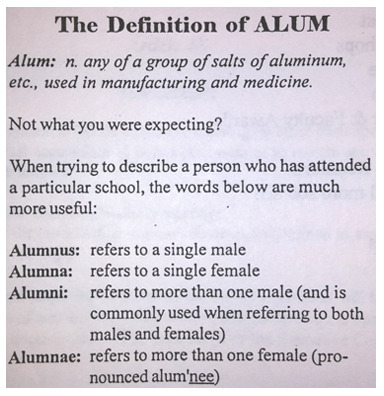
The Order of Bell Tower was chartered on Oct. 22, 1980 with 58 members. OBT was officially recognized by UNC's Vice Chancellor of Student Affairs and the Department of Student Life on Nov. 19.
"It was a success from the beginning," Saunders said. "People took it seriously. It was a service group, not an honorary where you sit on your laurels. People were really motivated to do things."
Perhaps the first thing they were motivated to do was to set up an office in a closet on the third floor of the Alumni House next to the Carolina Inn. There was a massive old desk taking up most of the room with an eclectic assortment of cast-off furniture including a comfortable aged wing chair.
With a new office, and after developing a Constitution, the group went to work. "We had the enthusiastic support of the Alumni Association," said Scott Norberg '82, a charter member of the OBT who would become student body president the next year. "My most vivid memory is of making some exam survival kits that first year."
In fact, that was the first project and the Order of the Bell Tower raised more than $2,500 by putting together and selling 1,000 exam kits.
The idea was to gather items that students could use while studying for exams and then selling the kits to the parents who would provide a note of encouragement to their son or daughter.
The kits contained food items, mostly provided by Fowler's for cost, including fresh fruit, raisins, granola bars, cheese and crackers, hot chocolate, etc. The kits also contained blue books, pencils, aspirin and other non-food items provided mostly by the UNC Student Stores, Triangle Advertising and Kendall Drugs.
The items were delivered to a room at the Union where OBT members had assembled.
"We had a good time putting the kits together," said Norman, the membership chairman who is now the director of alumni relations at the UNC School of Education. "It was as much of a team-building exercise as anything. The room would smell like apples and oranges for two or three days."
Those first kits, priced at $5, were hand delivered to students Dec. 5-7, 1980. "It was such a novel idea and parents were thrilled to send something to their child with a personal note," Norman said.
The exam survival kits were put together in the same manner for almost a decade more with proceeds eventually reaching nearly $10,000 a year. The novelty of it wore off as outside groups started doing the same thing and the OBT turned to a pre-packaged kit where the members simply facilitated the order process and shipped the items.
In 1986, an unrelated outside group posed as a University organization called University Care Services, even putting the Ram mascot on their letterhead. The cost of the exam survival kits was $10.95 while for an extra $7.95 parents could send a cookie gram. Most were never delivered.
In 1990, a similar outside group named Student Reach sold Cram-Gram exam kits for $20 but never delivered them. Some parents complained to the Order of the Bell Tower, confusing the OBT with the scam groups.
Norman talked to parents and sent letters clarifying that the OBT's exam survival kits would be delivered. "Each year other companies come in and use the campus phone directory to mail to parents of undergraduates information concerning their exam kit," Norman wrote to parents. "These groups change their names from year to year and are often outside of North Carolina . The University and the Order of the Bell Tower have received bad publicity. Often the individuals involved with the generic 'student reach' organization are impossible to identify."
Despite that hassle, and the fact that a snowstorm nearly paralyzed Chapel Hill the weekend the kits were to be delivered, OBT members managed to get exam survival kits to 1,750 undergrads that year at $10 per kit. Norman said from the beginning OBT felt like it needed to become self-supporting because the it wasn't really qualified to get money from the student activities fund since the group was sponsored by the GAA. But the GAA didn't have the money it does now to contribute, she said.
Not a lot of money was needed that first year as much of the $2,500 raised went to send four students to Houston to serve as hosts and hostesses for the alumni at the Astro-Bluebonnet Bowl on Dec. 31, 1980.
On the way, the bus carrying the OBT students and alumni drove through the night, stopping at the famous Varsity in Atlanta for burgers and hot dogs. As for the game itself, the Tar Heels came into the game with just one loss on the season but were playing a Texas team with a decided home field advantage.
"It was a night game, very exciting atmosphere, probably the biggest crowd I had ever been in up to that point," said Sharon Lawrence '83, who served as one of the hostesses for the alumni. The OBT put its best foot forward and so did the Tar Heels who defeated the Longhorns 16-7 behind touchdown runs by game MVP Amos Lawrence and Kelvin Bryant.
Members of the OBT ran into defensive star Lawrence Taylor after the game at a celebration event at the hotel. Taylor was in a speech class with Lawrence. "He recognized me, picked me up in a friendly hug and identified me thereafter as 'Little Lawrence,'" Lawrence said.
The Tar Heels football program had become well known on the national level as they finished the season 11-1 and 10th in the final rankings. Meanwhile, the Order of the Bell Tower had become well known with the alumni and North Carolina dignitaries who attended the event.
"I remember the excitement I felt at being part of the outreach from our generation to the graduates who represented the promise and potential of our future," Lawrence said. "Based on what I was exposed to during that time, my assessment of the student mindset in the early '80's was that we looked up to adults. We were reaching for our maturity and to belong in the adult world. So connecting to graduates felt like a privilege rather than duty."
In early 1981, the OBT held a two-day retreat at Camp New Hope that brought the members closer together as they played games, socialized while eating, brainstormed future projects and adjusted the bylaws.
Evaluations of the retreat show that Sharon Lawrence '83, who would go on to become an accomplished actress, stole the show with a one-person skit meant to wake everybody up.
One person wrote that "Sharon 's performance was sidesplitting and not fit for alumni to hear." Another wrote that his favorite part was "listening to Sharon dahling." And, for the ultimate compliment, one evaluator wrote, "I'd like to have a banquet where Sharon Lawrence does an encore performance." Unfortunately, there is no known video or transcript of the performance. And Lawrence doesn't remember the performance which was noted in the retreat minutes as "Sharon 's Alumni Chapter meeting speech."

Lawrence, who performed on campus at the Paul Green Theater and Playmakers and off campus at Slug's In the Pines restaurant and Mr. Harvey's Bistro in Durham, believes she probably incorporated a song from "City Lights," which was a review of Broadway hits by composers Kander and Ebb. "It was considered racy then," she said. "I have a feeling it would be pretty mainstream now."
Perry, the OBT's first president, saw Lawrence in 2015 at an event honoring UNC interns who had worked in Hollywood during the summer. "Seeing her immediately took me back to circa 1981 as her enthusiasm and joy for Carolina seemed as strong as it was back when we all were trying to build OBT," Perry said.
Lawrence said up until her joining the Order of the Bell Tower she had seen very few young African-American men in leadership positions. "Al Perry made quite an impression on me as a leader ," she said. Perry's reign as president was actually a short one as new elections were held the fourth week in March of 1981 - the same week that President Reagan was shot, and the Tar Heels beat Virginia in the national semi-finals behind Al Wood's 39 points before losing to Indiana in the finals.
Harriet Morrison '82, the vice president, was overwhelmingly elected president. "Harriet is a real go getter and OBT took off under her," Saunders said. "She was one of the most organized individuals and was able to motivate people to make it even better."
Morrison also became a voting ex-officio member of the GAA board. (That policy stayed in place until 1991 when it was decided by the board that the 16 ex-officio members, which included the OBT president, could participate in discussions but could no longer vote.)
A membership drive added 30 more OBT members for 1981-82. Even though some seniors graduated in May, the group was 80 strong less than a year into its existence.
Despite the large number, Morrison - who later served on the General Alumni Association board under her married name of Loweth - said there was unity. "We were brand new and trying to prove ourselves," she said. "There's a thrill when you succeed."
Succeed they did but it took many of those 80 people to keep up with all the demands. In addition to exam survival kits, OBT was gearing up to produce the Freshman Register (complete with pictures of incoming students) and to hold workshops at North Carolina high schools telling students what it is like to be in college.
If that weren't enough worker needs, OBT members were speaking at various alumni receptions and local meetings throughout the state talking about the new student-alumni group and telling alumni what it is like on campus.
OBT member Perry Morrison '84, Harriett's brother, who himself became OBT president his senior year, remembers traveling to local alumni chapter meetings with UNC legends such as UNC system President William C. "Bill" Friday, Chancellor Christopher Fordham III, Athletics Director John Swofford, Rams Club President Moyer Smith and distinguished author and professor Doris Betts. "Talk about the thrill of a lifetime," he said, "to get to spend hours of one-on-one time with the very people who were my idols."
He used to drive back late at night from distant towns like Morganton and Whiteville. But once he got to fly. He got a frantic call to be at the Horace Williams Airport in an hour with a coat and tie on because he was going to an alumni event. He hopped on the Cessna and sat in the back with none other than Bill Friday. "We were headed to Edenton to attend an alumni event to discuss the gift of the Hayes Plantation Library, which is now recreated in the Wilson Library on campus," he said.
Morrison, now an attorney in Wilson, remembers flying back in total darkness as he and President Friday tried to identify towns in Eastern North Carolina by the twinkling lights below. What a memory to have.
Kay Sowers '84 said her most vivid memory of OBT was traveling to an alumni meeting in Whiteville with Voice of the Tar Heels Woody Durham. Others had planned to go but icy conditions from a snowstorm caused them to cancel. Durham was the keynote speaker so he decided to drive himself.
"I decided not to turn down the opportunity to spend five hours in a car with Woody Durham," she said. Sowers fretted over her speech, knowing the people were there to hear Durham and she was worried that people wanted to get home before the weather conditions worsened.
"I told Woody that at least I was speaking before him," she said. "He was an act I didn't want to follow." But when it came time for her to speak, the emcee forgot about her and introduced Durham.
"Woody, as he always does, entertained the crowd for a good half hour with great anecdotes about UNC sports," Sowers said. "But then the emcee remembered me and introduced me. I couldn't believe it. I knew those people wanted to hit the road home."
She had prepared an energetic commentary about current life as a Tar Heel so she got up and delivered it. "When I sat down, Woody had written a note on a napkin which read, 'I am so glad that I didn't have to follow you! You were great. Woody.' That is a night and memory that I will cherish forever."
OBT members increasingly got to spend time with dignitaries and well-known people as they were asked to be hosts and hostesses for various alumni and University events on campus as well as other organizations such as the North Carolina Press Association, which held yearly awards banquets in Chapel Hill.
Letters of thanks started pouring in from people who were appreciative of the OBT members help in putting on the various events.
One of the first letters came from Rollie Tillman of the Board of Visitors who praised Bobby Bosworth, Kate Cooper, Cindy Gregg and Anita Weinstein for helping with the Board of Visitors Meeting. "The Order of the Bell Tower was a big help in hosting these visitors," he wrote. "I appreciate your taking time out from a weekend schedule to help us. It meant a lot."
More and more groups started using their services. Members of the OBT worked class reunions, alumni club meetings, University Day and just about any group having a function on campus.
OBT members even served as bartenders. Professor David M. Lawrence of the Institute of Government needed help at a city attorneys reception and he got it from a pair of members of the Order of the Bell Tower. The two believed to have bartended that night were Lori T. Collins '82 and Susan Palmer '82, who is one of seven Order of the Bell Tower former members, as of 2017, who has since passed away, having died in 2011. "They were a grand help to my wife and me in putting on the party, and were not only efficient, but very pleasant bartenders," he wrote in a letter to Harriett Morrison. He joked about Palmer inventing a Scotch and tonic drink. "I don't think she'll make her fortune on it though," he wrote.
"The University is very fortunate in having your organization available for this sort of service," he wrote.
By 1982, Chancellor Fordham had recognized the Order of the Bell Tower as UNC's official hosts and hostesses, i.e. ambassadors, on campus.
"Once we became the official hosts for the University, we were asked to host special events such as installing a new chancellor or a last-minute request for a campus tour for a notable alumnus," Laurie Norman '83 said. "There wasn't an official visitors' center then so before OBT the admissions office was the only option."
Chancellor Fordham and his guests had been very happy with the OBT members who hosted the Chancellor's Box at UNC home football games during the 1981 season.
That tradition of hosting the Chancellor's Box has continued throughout the life of the Order of the Bell Tower.
"It was a big deal to host the Chancellor's Box," Laurie Norman '83 said. "Ray Jeffries ('47), the coordinator up there, knew everybody in North Carolina . We'd stand there with Ray and give out programs. He would take the time to introduce people to these students."
The students and alumnus, as well as other dignitaries, all seemed to have loved the interaction, and members of the OBT cherish those memories as much or more than anything they did at Carolina.
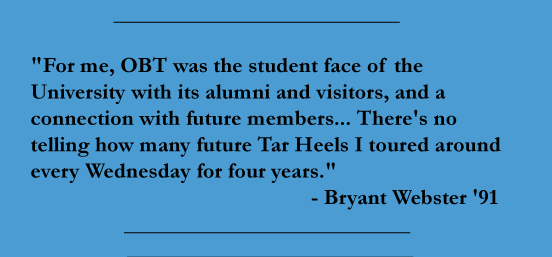
Bryant Webster '91 said his fondest memories revolve around helping host the Chancellor's luncheon before the game and the Chancellor's Box at the game. "For a farm boy from then-rural Durham County , it was quite a charge getting to rub shoulders with VIPs in the ornate banquet room of the Morehead Planetarium, and then playing host to those folks during the football games, and dressing up and moving among the adult world," he said.
As a student preparing for law school, he was pleased to meet and speak with attorney Wade Smith, who is recognized as a preeminent lawyer in the state. "For me," Webster said, "that was like being in the presence of royalty."
Despite the fact that OBT members enjoyed hosting the Chancellor's Box, it wasn't always easy to get them to volunteer for it. Some wanted to sit with their fraternity or dorms or girlfriend or boyfriend. Some wanted to pay more attention to the game. While still others didn't want to wear the Carolina blue blazers.
"They were begging fellow OBTers to don those hot blue blazers," Colleen O'Neil Yanchulis '84 said. "It wasn't always easy to convince people to work in the box, but I loved every minute of it."
One bright sunny Carolina blue Saturday, President Friday was sporting what Yanchulis described as "a snazzy tie" so she complimented him on it when he arrived. "Then I complimented him on it when he walked by during the game and again at halftime," she said. "After the third time, he offered to give it to me, even beginning to take it off!"
She laughed and declined, but his warmth and good humor over that tie and simply the sharing of that experience with President Friday made her feel that she belonged at UNC.
Dressed in those ill-fitting, sometimes overly warm blue blazers, the members of the OBT would arrive early on game days and get cushions out of an old wooden cabinet and place them on the hard stadium chairs.
"As development became more of an issue and who got to sit in the box became more of an issue, that era was outgrown," said Norman, who was a member of OBT for nearly three years before graduating and becoming the GAA's adviser to the group for 11 years. "After the Chancellor's Box was renovated, it became a whole different concept."
The Chancellors' Box was smaller, much smaller than it is now and it was not enclosed from weather conditions nor was it nearly as plush. OBT still hosts the Chancellor's Box, which was renovated and expanded in 1997, but it's different from those early, more intimate days.
Still, Harriett Morrison Loweth, the former OBT president from '81-'82, said that OBT members continue to have that infectious passion. "The students still brim with enthusiasm, still represent the University, and still host football games and mingle with important alumni in the Chancellor's Box," she said.
In fact, Jennifer T. Stephens '03 said the OBT's role at football games resonates the most with her about her years in college. "It highlighted the past, present and future of the Carolina community," she said adding that alumni, faculty, staff and administrators would spend a great deal of time with OBT members. "The alumni also would share the memories of their experiences as Carolina students and the ways that the spirit of Carolina live on in their personal and professional lives."
While it can be argued that the further back you go, the better the game-day experience was for members of the Order of the Bell Tower, one thing that's clearly better today are the blazers.
"We had to wear that horrid 100 percent polyester sick-blue Sears Blazer," Perry Morrison '84 said. "They came in varying sizes and none of them fit anybody!"
Laurie Norman '83 said that Ted Bonus, UNC's director of public information, insisted that OBT members hosting the box during the 1981 football season wear light blue blazers. "They were hard to find," Norman said. "Plus, we didn't have the money to get Alexander Julian or anything like that."
The OBT found some light blue blazers but there wasn't enough money to get everybody one. "We sort of had to get an assortment of sizes that would meet the needs of the girls and guys," Norman said. "People just didn't want to wear them - it just wasn't the thing."
At other events, OBT members in the early years opted to wear matching t-shirts or golf shirts. "The blue blazer idea didn't catch on at first but now it's great," Norman said. "They all have the blue blazers with scarves and matching ties. It's more of an outfit now than it was then."
South Moore '15, who served as president of OBT, credits that to C. Hawkins '00, adviser from 2013 to late 2015. "It's not hard to be the best dressed people at an event when your uniform is designed by Alexander Julian," he said.
During the 2010s, there were fewer opportunities to dress up as there was a drop off in the Order of the Bell Tower hosting campus events, Moore said. "When I started in OBT," Moore said, "the only time we interacted with the Chancellor was when we hosted the Chancellor's Box. We showed up, stayed for a quarter, and left. No one from the Chancellor's Office or University Events really seemed interested in us."
He blames part of that on OBT members being unreliable. "Once people realized that being unreliable would hurt our chances of being asked to help the Chancellor, they elevated their efforts," Moore said.
He said GAA staffers Hawkins and Rick Davis '85 worked hard to volunteer the OBT at every opportunity so that they could prove themselves again. "Getting us those really fantastic uniforms helped," Moore said referring to both how the students felt about themselves and how administrators and alumni felt about the students.
How students and alumni felt about Homecoming on the field was changing.
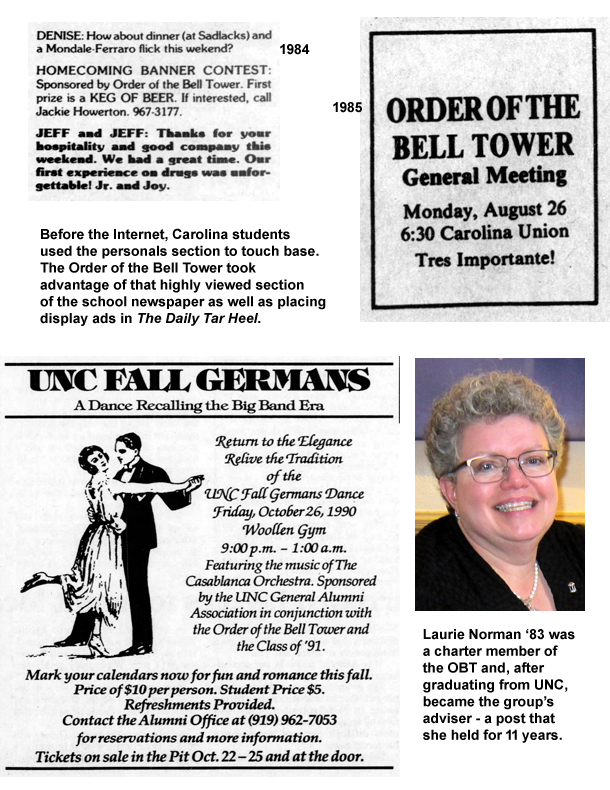
For several years, starting in 1981, the Order of the Bell Tower sponsored a banner contest, where the winning dorm, Greek organization or other group would win a keg of beer for best banner at the game. After all, the drinking age was 18 at the time. The OBT placed a classified ad announcing the banner contest in The Daily Tar Heel with the first words being "FREE BEER!" Appropriately, the ad was placed just below a notice for Ladies Lockout at Purdy's dance club where women were admitted for free and draft beers were 25 cents.
The banner contest revived a similar Homecoming decoration contest tradition that started in the 1930s and continued for more than three decades. The difference was that those banners were affixed to the dorm, fraternity or sorority house rather than being displayed at the games.
The Order of the Bell Tower, which nominated Sharon Lawrence '83 for Homecoming Queen in 1981, was heavily involved in helping the Carolina Athletic Association with Homecoming event planning for a number of years perhaps in part because OBTer Perry Morrison was the CAA president. In fact, in 1983 the OBT helped bring back the tradition of a Homecoming Dance - something it would also help do five years later with the revival of the formal Fall Germans Dance, a tradition that had been stagnant since the 1960s. In addition to staffing both dances, OBT members sold 1983 Homecoming Dance tickets for $2.50 for all those who wanted to dance to the tunes of the Embers.
But perhaps the traditions and the decorum that the Order of the Bell Tower sought from the beginning didn't always translate to Homecoming. Many alumni as well as student traditionalists didn't appreciate that a male dressed as a woman under the name Yure Nmomma won Homecoming Queen in 1983.
In what was what some thought an overreaction, the CAA did away with the Homecoming Queen in 1984 and replaced it with a Carolina 's Pride Award, to be awarded to someone deserving of recognition for a job well done on campus. The Order of the Bell Tower and the UNC General Alumni Association contributed a five-year GAA membership to the winner.
That year's CAA president Jennie Edmunson said the election of a Homecoming Queen had become an "abandoned" and "lifeless" tradition. While voter participation had dwindled over the years, evidently getting rid of Homecoming Queen altogether was not the answer as the tradition was back the next year.
A much more thorough process for nomination and selection of the Queen, where a faculty committee chose five finalists, was started in 1985. The committee looked at academic merit, personality, campus involvement and achievements. OBT member Jennifer Ferguson '86 made the cut from 20 seniors to five but she did not win the crown. Also as part of the Homecoming celebration, the Order of the Bell Tower contributed $1,000 to have UNC alumnus and ABC sportscaster Jim Lampley '71 speak at Memorial Hall.
By the mid-1980s, the Order of the Bell Tower regularly had more than $5,000 in the coffers with most of the money still coming from sale of the exam kits and the freshman registry.
Much of the money went to banquets, picnics, retreats and travel for OBT members driving or flying to events such as alumni meetings, high school student workshops and the national Student Alumni Association convention.
But travel costs were down a bit in 1985 since UNC's Order of the Bell Tower was chosen to host the third annual Southeast Regional Conference for the SAA. More than 100 students and advisers from 20 schools representing the nine Southeastern states attended.
During a welcoming reception, the Clef Hangers a capella group entertained the delegates and administrators. Attendees were treated to four days of Spring-like weather in February, which helped impress the visitors as OBT members took them on campus tours and lunches at the Kenan Field House, which had outdoor seating.
"OBT started to be seen as a well-organized group with longevity," said Laurie Norman '83, who was the OBT adviser when they hosted the regional conference. "People knew this was not just something started on a whim that would burn out after four or five years. The Order of the Bell Tower had become a regional leader."
By the end of the first decade of operation, the Order of the Bell Tower saw many other colleges form similar groups. And in 1990, OBT once again hosted a Southeast Regional Conference but this time there were more than 500 attendees.
Karin West Richardson '89, who was in OBT all four years and served as president as a senior, attended her first SAA conference - the nationals at UC Santa Barbara - and realized that the Order of the Bell Tower was well respected.
"I was lucky enough to attend all of the regional and national SAA conferences during my time with OBT," Richardson said. "UNC generally led two or three sessions at each conference... We took these sessions very seriously and always received the very highest reviews from attendees."
She was able to bring back some ideas from across the nation but the Carolina students were probably even more helpful to the representatives of other schools.
"We were certainly in the first 10 major universities to embrace the student-alumni concept," Norman said. "Some at the other colleges were strictly ambassadors and grew out of the student admission offices."
Norman said at some of the conferences OBT members attended, they were the only ones sponsored by an alumni association. "Others had a more of a meet-and-greet goal while we had a different mission," she said.
From the GAA's perspective, the original mission was "to acquaint students with the GAA while they were still at Chapel Hill, in hopes that they would join the association and remain involved in the future," Harriett Loweth said.
In particular, Bo Dunlap, the group's first adviser, said the GAA wanted to clear up confusion that students and many alumni had in differentiating the Alumni Association (GAA) from Annual Giving (AAG) and other alumni and fundraising groups on campus. The idea was that "OBT members, who would by association with the GAA learn the difference, and could, over time, spread by involvement, action or dialogue to the general student population exactly what the GAA was all about," he said.
Just as the Order of the Bell Tower members were much more than ambassadors showing people around campus, they turned the OBT into something much more than just knowing what the GAA is and passing the word along. They turned into an effective service organization with many hats.
Through most of the 1980s, the Order of the Bell Tower had six standing committees and several individual committees working on diverse projects. The standing committees varied a bit from year to year but generally were: Commencement/Reunions, Homecoming, Host, Membership, Publicity and Social. The individual committees included the Exam Survival Kit, the Freshman Registry and High School Workshops.
Kirby Pfeiffer Sheridan '86 worked with Norman, the adviser at the time, and other students to create a fair and consistent application process for admission into the Order of the Bell Tower as well as committee assignments.
"That experience stands out to me," Sheridan said. "I also participated as an interviewer of candidates for admission into OBT. That was an experience that was applicable to my career experiences later."
Perhaps the most distinct memory Carolina Berndt Mew '96 has of the Order of the Bell Tower is being on the other side of the interview process. Her interview to gain entrance into OBT was on a rainy Saturday morning and it didn't dawn on her to dress to impress. "I arrived wearing standard college-student attire, rainy-day attire at that," she said. "When I arrived I saw other candidates wearing suits or similar dress clothes. I assumed that I was doomed."
Fortunately for Mew, that was not the case. "This reflects, I believe, that OBT was more about substance than form," she said. "However, I also was careful thereafter never to under dress for any OBT function."
Several responses to an OBT survey in 1989 had warned about picking students for membership based on popularity rather than looking at whether or not they are over-extended. "Active students are active because they are good at applications and interviews," one member wrote. "But do they really have the time to commit to OBT?"
Norman said as OBT became better known it became harder to get into the Order of the Bell Tower, which she reminds people is an honorary as well as a service group.
"We didn't just want it to be open where anybody could get in but we wanted people who were gonna take it seriously, make a commitment, come to meetings, take part in the activities," Norman said.
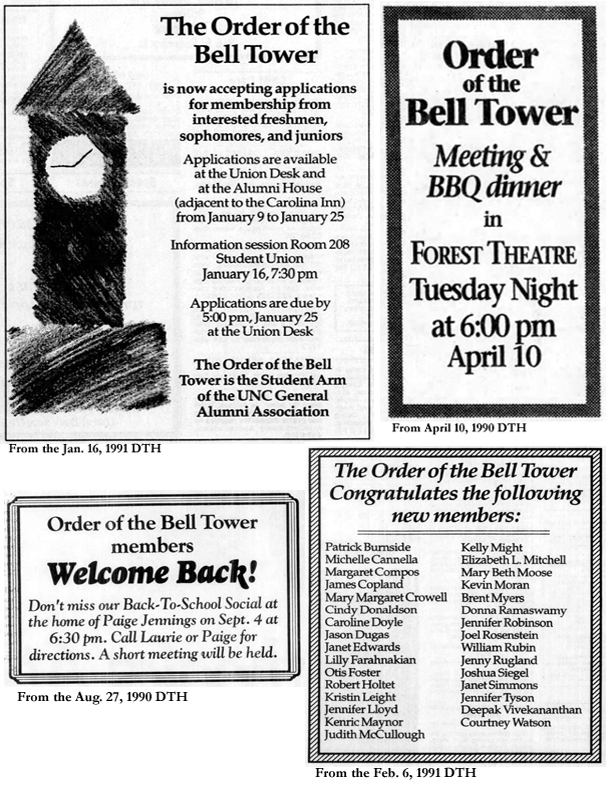
Other than word of mouth, display ads in The Daily Tar Heel as well as letters to the editor and news articles in the paper were the main way OBT recruited members. Arguably more people saw the tiny but well-read classified ads that OBT would put in The Daily Tar Heel to announce its meetings. Anyone who went to Carolina remembers the personal messages that flooded the classifieds. For instance, just above a straightforward meeting announcement for the Order of the Bell Tower, there was a message that read, "Dear Jellybean. Thanks for the best year I've ever had. I hope our future together will be as bright as our past. Happy Anniversary, Talmadge."
Many of those who were admitted were very active in other activities on campus and while they had good intentions, they didn't really get very involved with OBT. If a member missed three meetings without a prior excused absence, the Membership Committee sent them a letter of inquiry and often ended up removing them from the roster.
"There's always somebody that bites off more than they can chew and they fade away," Norman said.
As one former member said, "Unfortunately I did not take advantage of this great opportunity. The stupidity of youth so gets in the way sometimes."
Others stayed in OBT but admittedly didn't contribute much. "Embarrassingly, I am struggling to come up with distinct memories of my OBT time," another former member said. "My involvement was somewhat limited given other demands during those years."
Former OBT president Harriett Morrison Loweth '82, on the other hand, said until the Order of the Bell Tower came along she "just wandered around going to class, experiencing Carolina and sewing some wild oats." She said she spent her time in Spencer Dorm, in class, at various mixers, in the Union and on Franklin Street "dancing at Crazy Zack's and Purdy's" and when she wasn't cooking on a hot pot in her room she was "eating at Spanky's, the Waffle Shoppe, Four Corners, Hector's and the Porthole."
While she did work on her friend Joe Buckner's campaign for student body president, once he lost to Scott Norberg, she had time on her hands again.
After going to the first OBT meeting, "I found my calling at UNC and the door to my future, though I didn't know it at the time," Loweth said. She said the charter members list was a veritable "who's who" on campus who "already had too much to do" and who had other passions.
As a result, despite the enthusiasm for OBT, from the beginning (and continuing today) manpower was often an issue.
The issue of members missing meetings or the group being shorthanded for events has been addressed in many of the minutes throughout the life of the Order of the Bell Tower. All kinds of techniques have been tried from making some events mandatory to taking attendance in the middle of meetings so people couldn't skip out early. A point system has been tried and modified over the years where members get points for attending meetings and staffing events. Not only do the points keep members in good standing but it gives them dibs on choice assignments.
Finally, there is pleading and pressure.
For instance, OBT leaders struggled to find people who would and could do the high school workshops out of town. It was a challenge in part because most the workshops were during the daytime and OBT members had class.
The workshops were suspended for more than a year in the '80s before they were reactivated in the late '80s. This time, students would travel to mostly area high schools, show a video and conduct a question-and-answer session. The response was positive and more and more high schools started requesting the workshop, the OBT's secretary Erica Riefenberg '91 said at the time.
"I feel really optimistic that this will continue to be an area of growth for OBT," said Riefenberg, who would serve as OBT president in 1990-91.
However, over the years the concept morphed more into receptions for high school students who had already been accepted into UNC. Of course many of the students had been accepted into multiple colleges so they were encouraged to enroll at Carolina. OBT no longer put on the events - the Admissions Office did - but OBT members attended and spoke with the students, travelling as far as Atlanta and Washington, D.C.
In the mid '80s, OBT members were expected to take part in what were called "telethons," where calls were made to alumni to get them to join the General Alumni Association or to renew their membership. Much emphasis was placed on getting "volunteers" to the events which were held over several evenings from 7 to 9:30. It was challenging because of the time involved as those taking part also were expected to attend training sessions. OBT members worked up to 10 hours over four nights, not including the training.
Minutes for an OBT meeting that addressed one of the early telethons underlined the word "voluntary" regarding telethon participation. "I think we understand the meaning of this!," the minutes read. Students were given a small hourly pay, which varied by telethon but started off at $3. Plus, there was a bonus given for the three students who got the most new membership pledges.
The incentives and the not-so-subtle pressure worked as evidenced by the first telethon in 1984 which got membership pledges from 1,532 alumni.
The telethons, set up in the basement of Hanes and then Howell Halls, were held in the fall and the spring over 9 to 14 days. With the manpower needed, OBT dropped the pretense of the participation being voluntary. Minutes from one OBT meeting in 1985 stated, "Each OBT member is REQUIRED to attend one training session AND four nights."
Kirby Pfeiffer Sheridan '86 said it was the only paying job she held while on campus. "I dreaded it," she said, "but I found that most alumni were very pleasant when I called them."
While the OBT and the GAA no longer hold these telethons, Sheridan said that the telethons and other projects provided a good way for undergraduates to interact with alumni and the General Alumni Association.
OBT also offers students not Tar Heel born or bred a good way to interact with many aspects of the University.
In the 1980s, only 15 percent of incoming freshman were allowed to be from out of state while today 18 percent of incoming freshman are allowed to be from out of state. So, in the 1980s there were generally only about 15 percent of the entire undergraduate school from outside North Carolina.
As for freshmen today, there is a cap of 18 percent but, with transfers, the entire undergraduate student body stands at more than 19 percent from out of state. The 2015-2016 Order of the Bell Tower had only 22 members with eight from out of state or 37 percent of all members.
Even though all the leaders of the Order of the Bell Tower the first couple of years were from in state, by the mid-1980s 20 percent of the members of OBT were from out of state.
In fact, in 1985, two of OBT's five elected leaders were from out of state while other committee chairs were as well. At the time, Social Committee chairman Sarah Shaffer, from West Virginia, said out-of-state students find it hard to socialize so they get involved in organizations to meet people. Shaffer said OBT's out-of-state membership increased from 1984 to 1985.
Sandy McKenzie '86, who served as Secretary of OBT in 1985, said at the time that out-of-state students who were children of UNC alumni tended to be more interested in being a part of the Order of the Bell Tower.
While that certainly was and is true, out-of-state students disproportionately hold leadership roles throughout campus.
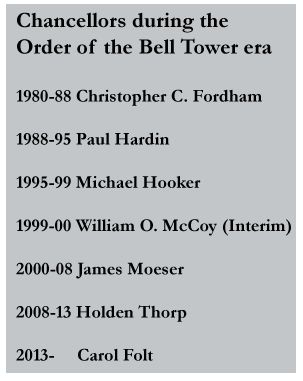
Just as interest from out-of-state students was increasing, there was another more noticeable change for the Order of the Bell Tower. The OBT had to say goodbye to one of its biggest advocates in Chancellor Fordham, who had started his job the same year that OBT started.
In 1988, the OBT had to get used to another Chancellor, who had his own way of doing things. OBT president Karin West Richardson '89 went hard after Chancellor Paul Hardin's support with a letter of welcome and explanation about what the Order of the Bell Tower does and can do for him.
As it turned out, Chancellor Hardin was very familiar already with OBT. "Let me thank you for the wonderful work which is done for all of us at UNC by the Order of the Bell Tower," he wrote in an Oct. 3, 1988 letter. "I have become aware of that work by personal experience and observation." He said the group had already been tremendously helpful to him, his office and his wife.
He agreed to attend a reception hosted by the Order of the Bell Tower where he expressed his appreciation for the OBT.
One of the issues Hardin jumped into involved the building of an alumni center. The $12.5 million George Hill Watts Alumni Center, funded entirely by private funds, came to fruition on his watch and with his support but not before some angst about where the building should be located.
Students at residence halls close to Stadium Drive had objected to the proposed site of the alumni center. And they got some support from then-OBT president Darrin Poole who not only was concerned about the number of trees that would need to come down but he was also concerned about student parking.
General Alumni Association president Doug Dibbert '70 assured students that the alumni center would be nestled in the trees and that natural landscaping would enhance the area.
There was some disagreement among OBT members after the initial plans were made public. Karin West Richardson, who later would become president of OBT, supported the location.
While Poole was expressing concern, Richardson wrote a letter to the editor in The Daily Tar Heel telling students that the alumni center was "much needed" and would serve them well in the future.
"It is not to be used only by million-dollar donors," she stressed. "It is for everyone. This will be your home base when you return to UNC." She explained the normal approval process that had taken place and pointed out that there was student participation and input along the way.
By the time Richardson was president of OBT, the tide of opinion - at least from the Order of the Bell Tower perspective - had become one of solid support for the location of the alumni center.
There had been an expectation that the alumni center would be built near the location of the Dean E. Smith Student Activities Center, which opened in 1986. But the Stadium Drive site, next to Kenan Stadium, was picked instead.
"The site was chosen due to its excellent central location, which will provide access by foot to any campus event or facility," Richardson wrote.
Groundbreaking of the alumni center took place in 1989 and in May of 1993 the George Watts Hill Alumni Center officially opened. The OBT had come a long way from the initial closet room in the old Alumni House next to the Carolina Inn. The OBT now had a large room on the third floor overlooking the breezeway between the two sections of the building.
The Clef Hangers, the oldest a capella group on campus having been founded in 1976, became a part of the GAA through the Order of the Bell Tower during the '89-'90 school year and began using the OBT space for practice.
"As the staff of the alumni association has grown and resources have grown, they have been able to do more things," said Laurie Norman '83, who was the OBT adviser from '83 to '94. "With the Clef Hangers, the GAA started sponsoring additional groups beyond the Order of the Bell Tower. The alumni association is just so much more integrated with student activities now."
The UNC Loreleis, an all-female a cappella group, also now falls under the GAA umbrella. In addition, three other groups besides the Order of the Bell Tower, are now sponsored by the General Alumni Association: the Homecoming Committee, the Senior Class and the Student Alumni Association (SAA).
The SAA, founded in 1995, unlike the Order of the Bell Tower, is available for all current UNC students. As such, it is the largest student organization on campus. Members get benefits, like discounts, and are afforded fun opportunities to interact with alumni. Membership in the Student Alumni Association is considered a precursor to a future UNC General Alumni Association membership.
The SAA and all the GAA student groups are led by student leaders while the GAA provides staff advisers, meeting and office space, and financial support to them.
Student leaders on campus often come from these groups, particularly the Order of the Bell Tower. In fact, in 1992, five OBT members were elected student government leaders. John Moody '94 was elected student body president; Bob Paty '93 was elected senior class president; Elizabeth Mitchell '93 was elected senior class vice president; Kristen Davis '93 was elected senior class secretary while Jennifer Lloyd '94 was elected speaker of the student congress.
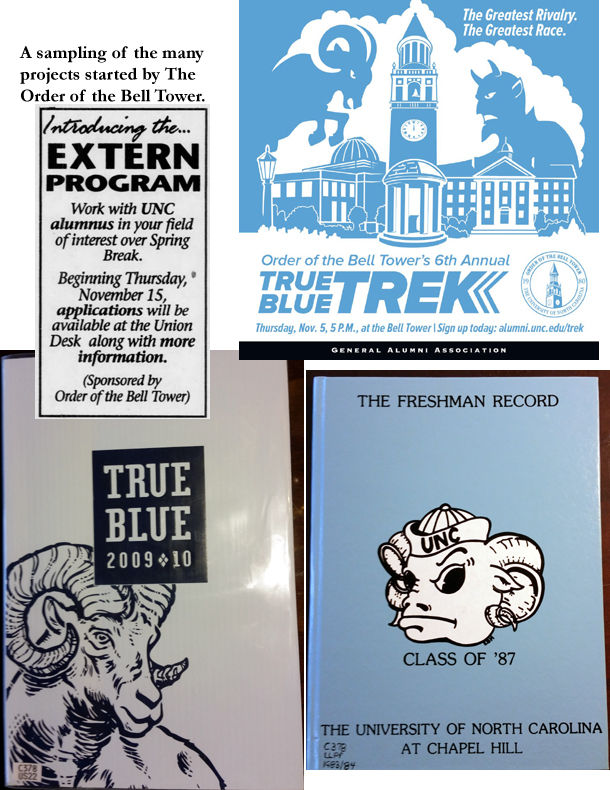
The early '90s were a busy time for the Order of the Bell Tower as a major new effort was planned and started - the Extern Program, which gave an opportunity to work with professionals in their area of study for three to five days over break.
In 1990, the OBT, in conjunction with the UNC Office of Career Planning and Placement, conducted a survey of Carolina alumni to gauge interest in working with students on the program. As a result 70 individuals and companies agreed to take part if called upon.
The OBT's Extern Committee, chaired by Christy Youngblood '91, publicized the program on campus and matched 24 interested students with "sponsors" including IBM, Price-Waterhouse, NCNB and Revco Pharmacy.
The first externships started in good spirits March 11, 1991, the day after the Tar Heels defeated Duke for the ACC Tournament Championship and ended March 15, the day the Tar Heels won their first NCAA basketball tournament game over Northeastern on the way to the Final Four, where Dean Smith's Heels would fall to Roy Williams' Kansas Jayhawks in the semi-finals.
The program - open to sophomores, juniors and seniors - was based on a similar successful program at Purdue and, by all accounts, got off to a good start. Both the students and the alumni showed a high level of enthusiasm, Youngblood told The Daily Tar Heel. "Because of the strong influence of the alumni, we were able to get good matches so that the students were able to pursue career interests and the alumni were able to give something back to the University," she said.
Laura Snideman '91, an Interdisciplinary Studies major, spent her externship in snowy Washington , D.C. at the North Carolina Governor's Office there. She told The Daily Tar Heel that she learned a lot and particularly liked having a UNC alumna as her sponsor. "I think that it was easier to relate," she said. "Basketball was a definite common base between us."
Most of the students who took part were not members of the Order of the Bell Tower but some were. Katherine Boney '92, who chaired the Extern Program during the second year when 40 students were matched up, spent the first year's externship at Omega Sports with alumnus Alan Lloyd '84, who is now the executive director of the company.
By its fourth year, the program had expanded to include both Winter and Spring breaks with 25 to 30 students taking advantage of the program each time. OBT member Betsy Oliphant '96, who would later become president of OBT and in 2008 become an elected member of the General Alumni Association Board, changed her major from broadcast journalism to communications studies after her externship in Pittsburgh in order to pursue media production.
"I am proud to say this move has ultimately helped me reach my goals of working in international sports media and children's television," Oliphant wrote in a Bell Tower Alumni Newsletter. "My OBT experience greatly shaped my Carolina experience. And many of the skills and relationships strengthened through the group still impact me today professionally and personally." She worked in various capacities at ESPN for more than four years after college and later spent more than six years in children's television including five as director of production for Sprout. She is currently director of advertising for Visit Philadelphia.
The students were responsible for their own housing, food and transportation but that wasn't the reason the program ended after nearly 15 years.
Over the years it became more and more difficult matching increasingly very specific requests for externships. It was an onerous, time-consuming and often frustrating project. Sometimes alumni volunteers wouldn't be matched for three years or more. By that time they might not remember having signed up or their position had changed or they might no longer be at the company.
Sometimes the Extern Committee ended up cold calling alumni, not previously signed up for the program, to see if they might be a good match for a certain request.
"I thought it was really a great program," former OBT adviser Anita Walton said. "It got to the point that if we had a few matches that was great but the labor was overwhelming and we had to deal with disappointed students who didn't get a match." Or students who didn't get an accurate match. Surveys from students taking part in the Extern Program increasingly indicated that the matches weren't good ones.
While it was an important program that started strong, with all the other programs OBT was juggling, it never got as much attention as would be needed to make the program efficient. As a result, despite winning a Council for Advancement and Support of Education (CASE) outstanding program award in 2002, the Extern program ended in the mid-2000s.
In the early 1990s, the Order of the Bell Tower was very involved in the University's Bicentennial, mostly hosting the myriad of events associated with the multi-year observance of the birth of public higher education.
The Bicentennial Observance began on Oct. 12, 1993, which was the 200th anniversary of the laying of the cornerstone of Old East, and continuing into May, 1994. But the Bicentennial Campaign, which was a major fund-raising effort, started in October of 1991. The Order of the Bell Tower was involved with both.
OBT started by hosting the Bicentennial Gala at the Smith Center with Charles Kuralt as master of ceremonies. Kuralt was an award-winning broadcast journalist known for his On the Road segments for the CBS Evening News who was serving as host of the CBS Sunday Morning program at the time.
Kuralt, who wrote a book titled North Carolina Is My Home and whose brother owned the Intimate Bookstore on Franklin Street for many years, spent quite a bit of time in Chapel Hill over the years.
Laurie Norman '83 got a chance to meet him both as a student working with OBT and again during the Bicentennial when she was the OBT adviser.
"As a student, the experience was an amazing opportunity to meet alumni, some famous like Charles Kuralt, but who all had a tremendous affection for Carolina," Norman said. "Representing this University was pretty special for a first generation college student from Wilkesboro, North Carolina ."
OBT members throughout the years, until his death in 1997 at the age of 62, got multiple chances to meet and speak with Kuralt as they served as official hosts. He often was involved in campus activities and even delivered the Commencement Address in 1985.
It was another Carolina grad - singer/song writer James Taylor - that got other OBT members excited. "We as OBT members participated in amazing event at Smith Center," said Courtney Wilson '93, referring to the Bicentennial Campaign kickoff in 1992. "Lots of celebrity alumni were there including Alexander Juilian and James Taylor. James Taylor was a surprise and even the OBT members didn't know he was going to be there."
She said it was a magical night filled with school spirit and good music. "Everyone went wild when JT came out via this tunnel in the Smith Center," she said. "It was a very cool experience."
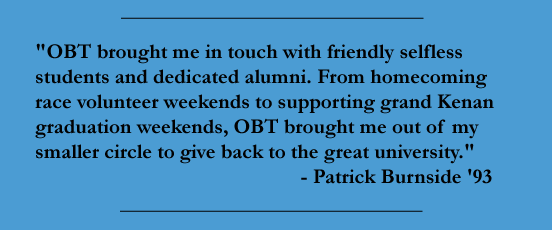
Patrick Burnside '93 said that night was the best memory he has from his time with the Order of the Bell Tower. "It was an amazing fundraiser," Burnside said. "None other than (renowned clothing designer) Alexander Julian shakes my hand firmly at the greeter entrance and says 'young man, when is the great James Taylor taking the stage?'"
He said the intimate performance by Taylor, who of course had Carolina in My Mind in his repertoire, is etched in his memory "for the ages."
Wilson said OBT shines at such events. "It is the best as THE organization to serve as ambassadors for the University, and to be the student presence and student arms/hands at all alumni events," she said.
Kudos came in to the Order of the Bell Tower for its work at the Bicentennial events but there also was some concern that OBT president Brian Baynard '92 had regarding members drinking alcohol at the Bicentennial Gala, the event with Charles Kuralt.
Baynard wrote the members privately about the issue. "I have chosen to keep this issue between us," he wrote. "I do not feel comfortable excluding (adviser) Laurie (Norman) from this matter but I honestly believe the situation can be resolved easily."
Most years, a code of conduct sheet was provided to those working as hosts for events. Among the items telling OBT members how to dress and the manner in which they should socialize, there was a section on Food & Drink which stated: Members will allow University guests to eat first at all events; alcoholic beverages will not be consumed by members.
Baynard blamed himself for not communicating the policy clearly in advance. "I realize that the majority of you were not drinking at the gala," Baynard wrote. "Since I do not know the extent of the problem, I think it best to address all members present."
Baynard let them know that the official policy, written in the group's Constitution, is that OBT members can't drink alcoholic beverages at official events nor can they come to events after they have been drinking. "Any mistakes in this area could certainly jeopardize memberships as well as future events for the organization," he wrote.
Since the drinking age in North Carolina had been raised from 18 to 21 five years earlier, the admonition was even more important as about 75 percent of OBT members were under age.
Prior to 1986, the OBT internal official social events - like annual banquets, new member orientations, picnics, etc. - routinely included alcohol. Since then, if there were drinking it was not done quite so openly and certainly wasn't served.
"Social events were fun and, as you may remember, the drinking age was still 18 (in the early 1980s)," said Harriett Morrison Loweth '82. "The fellowship of banquets, retreats and events created shared memories and shared goals, consequently uniting the group and deepening ties."
Having no alcohol at the social events - which have also included informal get-togethers like bowling and skating and going to Durham Bulls games - doesn't seem to have lessened the fun factor in more recent years. Scott Nelson '15 said one of the things he will remember most about OBT is the new member retreat - or "newbie" retreat as it is fondly known - when he was inducted into the Order of the Bell Tower. "My newbie retreat was at Marbles Children's Museum in Raleigh," Nelson said. "I remember staying up all night playing games, eating lots of candy, and pulling pranks on each other."
As a freshman, out of the house on his own, he said he was supposedly all grown up but "it was a lot of fun acting like a kid for a day and really bonding with people who I had only recently met."
In between Loweth's and Nelson's time was Tanea Pettis '95, who served as adviser for the Order of the Bell Tower from 1999 to 2005. Pettis oversaw OBT social events after the 18-year-old legal drinking era." The new member retreats were a favorite of mine," she said. "This provided returning and new members the chance to get to know one another in a social setting that was fun and relaxing. As an adviser it allowed new members the chance to get to know me in a laid back casual setting."
While the retreats took place near the beginning of the school year, the annual banquet took place at the end of the year. In the early years, the program always started with a cocktail party and included alcohol during dinner.
By all accounts, there never seemed to be any problems associated with alcohol at the events. "Social occasions always add to the general camaraderie," said Laurie Norman '83, an OBT member for three years and the adviser for 11. "We worked hard at our various events and enjoyed celebrating our successes with a banquet each year. We often had a guest speaker and invited campus dignitaries."
One of Norman 's most cherished items is a signed note from someone who declined the invitation - UNC coach Dean Smith. Banquets took place at such locales as the Morehead Planetarium, the press box at Kenan Stadium and in the old Field House at Kenan Stadium. "These things may not be a big deal to students today but it was in the '80s," she said. In general, more recent banquets have been more informal and at less prominent locations.
While there were no problems with alcohol in the first decade, there was a problem in the 1980s that, while an ugly situation, was dealt with swiftly and as quietly as possible. The OBT Executive Committee asked for, and got, the resignation of one of its student leaders. While the abuses weren't enumerated in the letter asking for the student's resignation, one issue was that the person was getting extra football gate passes for friends and family, who he would then allow into the Chancellor's box.
The Executive Committee said that it had a responsibility to maintain the standards of the Order of the Bell Tower and that the person's "behavior has been detrimental to the reputation of the Order of the Bell Tower within the University community."
There were excuses and a second chance, the committee noted, "however, we have seen no change of attitude or adjustment of behavior."
Whatever negative feelings there might have been from alumni or campus groups that knew about the incident quickly vanished as the Order of the Bell Tower went on to finish out the football season as hosts. Catherine Williams, from UNC's Office of Special Projects, was a particular fan of the Order of the Bell Tower and she wrote a glowing letter following the football season thanking the students for a job well done.
"We could not 'do football' without you," she wrote. "And the fact that everyone has been charming, gracious, diligent and more than helpful is a giant plus." She also praised the OBT in a Daily Tar Heel article where she enthusiastically discussed the excellent job the members do as hosts. "They are very dedicated to the alumni and the University," she said. "We can't do without them. Anytime I need wonderful help, I call them. They're such an asset to the University."
In the 1990s, Williams asked for a great deal of manpower from the OBT on game days, including pre-game functions at various locations, usually the Carolina Inn or the Great Hall of the Union. Three people were assigned to work with nametags while four people were assigned to the Morehead and Bynum/Steele parking lots to assist guests taking shuttle buses to the pre-game reception. Two others were assigned at the location to direct guests to the proper room.
At least six and as many as eight more were needed in the Chancellor's Box during the game: two making sure the food area was neat and replenished, two handing out programs and monitoring the soda dispenser, two taking coats and hats and directing people to their seats, and two guarding the entrances to make sure non-invitees didn't wander in from the stands.
Throughout the 1990s, OBT went on to host a number of existing events, like the Chancellor's Awards Ceremony, where OBT members stuffed inserts into programs, ushered guests to their seats, assisted the caterers with set up and even poured punch at the reception.
While many of the regular events centered around the Chancellor, the OBT also hosted rare one-time events such as a 1994 reception for the Association of American Universities at the home of UNC system president C.D. Spangler Jr. on East Franklin Street. UNC co-hosted the event with Duke but it was the Order of the Bell Tower that was called upon to serve to the needs of guests and to escort them from the reception to the Morehead Building. Spangler instructed OBT members to "please chat with the presidents and their wives about your experiences on the Chapel Hill campus. I believe they will enjoy hearing the student perspective of campus life."
In the 1990s, the Order of the Bell Tower made an effort to be closer specifically to the senior class. The OBT started the "0-year reunion," a reception in the Spring for seniors to give them an idea of what the General Alumni Association offers them upon graduation. Free food and entertainment may have attracted seniors to the event but they also learned about a plethora of programs that could help them including the Alumni Senior Connection, a career networking service that put seniors in touch with alumni.
For those seniors who knew where they were going to located after graduation, the event also got them acquainted with the local alumni club in their chosen area. Plus, they were offered membership into the GAA at half price.
Mike Ferguson '92, who was senior class president as well as a member of the Order of the Bell Tower, helped further strengthen the bond between the OBT, the GAA and seniors when he started a Representative Marshal Program, designed to encourage interaction and involvement between various organizations of campus.
Prior to that, the Senior Class office was typically run by class officers and their staff. Advisors from various student organizations, including the Order of the Bell Tower, were added through that Representative Marshal Program for the 1992 school year. Over time the General Alumni Association has taken over as the official advisor to the senior class and its marshals.
Today, as the voice of the senior class, marshals plan activities to foster class unity and help select the Commencement speaker. But they also have taken on a lead role helping host various events that previously had been the work of the Order of the Bell Tower . For instance, they serve as the official marshals at University Day and at Spring and Winter Commencement activities prior to their own graduation. They also assist the GAA in soliciting new graduate memberships.
The Homecoming Committee, also under the GAA's umbrella, took on most of the Homecoming responsibilities of the Order of the Bell Tower as well. While the OBT used to coordinate with the Carolina Athletic Association on Homecoming, now the GAA's Homecoming Committee has brought a centralized organization to the effort. The committee is still in effect a joint effort with the CAA but in 2013 the committee officially moved from under the auspices of the CAA to being officially advised by the GAA.
The GAA was and is handling so much of the Homecoming events regarding the alumni that it was a natural fit. Now, the GAA also oversees the work of the students on the committee in regard to student activities such as the Homecoming Court. However, other groups such as the OBT and Greek organizations often have their own homecoming activities - sometimes coordinated with the Homecoming Committee and sometimes not.
There is still a banner competition but now the banners are on display at the Student Union and uploaded to the UNC Homecoming Facebook page where the voting takes place. Instead of the OBT giving a keg to the winners as in earlier days, the winners receive monetary awards of up to $175.
Similar to the Order of the Bell Tower, the Carolina Athletic Association's primary focus was not Homecoming so when the Homecoming Committee transitioned to the GAA, the CAA still had a full agenda. The CAA spends much of its time working to improve and publicize athletic activities to the student body, and to be the student voice to the athletic department. In particular the CAA coordinates the ticket distribution for men's basketball games and well as plans the Late Night with Roy season opening event.
The CAA also coordinates the Beat Duke Week. It just so happens that Carolina was playing Duke in football when the Order of the Bell Tower held its first officially organized OBT Reunion in 1995. Over the first 14 years of the OBT, members generally gathered rather informally for a cake cutting in celebration of the group's anniversary. But in '95, OBT President Betsy Oliphant '96 and OBT Social Chair Joy Starnes '96 were determined to hold a 15th anniversary reunion.
Invitations to attend the Nov. 18, 1995 home game against Duke were sent to all former OBT members whose information was up-to-date in the alumni database managed by the GAA. A block of seats was reserved for the game, whose starting time moved to 12 noon to accommodate television. Former members could stay at the Hotel Crown Park for a special rate of $59 per night. A pre-game event was held in a portion of the Alumni Hall at the George Watts Hill Alumni Center. In addition to former and current OBT members, various campus administrators who were instrumental in forming the Order of the Bell Tower were invited to the pre-game brunch buffet and cash bar.
The Tar Heels, under Coach Mack Brown, didn't disappoint as they defeated Duke 28-24 on their way to a 7-5 campaign that included a victory over Arkansas in the Carquest Bowl.
Five years later, the Order of the Bell Tower decided to hold a 20-year anniversary reunion and tried even harder to get former members to come back. By this time, the GAA had gotten even more focused on various Carolina reunions and devoted more and more staff time to the events. Slick mailers were sent out promoting the reunion in conjunction with the Sept. 30, 2000 football game against Georgia Tech. This time those attending could register securely online as technology had advanced.
Once again a block of tickets were reserved for the game, which started at 3:30 to accommodate ABC TV. Former OBT members could stay at the Comfort Inn University for a special rate of $75. The group gathered at 1 p.m. in a tented area outside Wilson Library on Polk Place at "Tar Heel Town," a new idea for fans to gather to shop, eat, listen to the Marching Tar Heels, meet Rameses and cheer for the team as the players and coaches walk by. They ate barbecue catered by Bullock's and shared memories of their days in college.
For instance, Julie Trotter '85 told a story about how embarrassed she was when she spoke at alumni club meetings and couldn't pronounce the names of towns and counties. She said it became painfully obvious that she wasn't a native of North Carolina. "I didn't know how to pronounce the counties," she said with a laugh. "We were in the eastern part of the state, and I absolutely massacred Pasquotank and Perquimans."
Audrey Ramsey '99, a recent grad who served as president of OBT, told a story about the time several OBT members went to Duke's campus on the eve of the Blue Devils basketball game against Carolina and rolled nearly every statue on Duke's campus with toilet paper. "It was totally mean and malicious," she said without an air of shame. "We put up Carolina paraphernalia all over the campus the night before the game and then were chased by campus security for the better part of two hours."
They talked about the acting career of former OBT member Sharon Lawrence '83. Her character had been killed off on the hit TV show NYPD Blue the previous year and she was currently starring in a show with Betty White titled, "Ladies Man." Perry Morrison '84 happily reminisced about how his involvement in the Order of the Bell Tower got him a date with Lawrence .
Former members talked about how they bonded so well during retreats and meetings and at various events, and how that had translated into lasting friendships. "I lucked out," said Thad Woody '96, adding that it was a good outlet for him socially. "It was probably the friendliest, most welcoming organization I've ever been a part of at Carolina."
Despite witnessing the longest pass play ever in Kenan Stadium when UNC's Ronald Curry threw to Kory Bailey for 78 yards, those attending the OBT reunion saw the Tar Heels fall to Georgia Tech 42-28. Carolina finished the season 6-5 in what would be Carl Torbush's final season as head coach.
The 30th birthday of the Order of the Bell Tower was a bit more low-key but perhaps more meaningful for some former members who climbed the Bell Tower, many for the first time. On Friday, Oct. 1, 2010, after making the trek back down the Bell Tower, current and former members gathered at the base of the Bell Tower for a mixer.
While some OBT members gathered at Homecoming against William & Mary on Oct. 30, 2010, it wasn't the most pleasant time for football and attendance was a bit down. The program was under scrutiny by the NCAA for possible rules violations concerning improper gifts and sports agents. Those OBT members who did gather saw the Tar Heels rally from 10 points down in the fourth quarter to beat the Tribe 21-17 after a 67-yard touchdown run by Johnny White with five minutes to play. Carolina finished the season 8-5 with a 30-27 double overtime victory over Tennessee in the Music City Bowl.
As social media has grown in popularity, OBT has reached out each year to get its former members to return for Homecoming but the numbers have been small. Several times over the years former OBT members have met late night on Homecoming weekends at Spanky's and Top of the Hill restaurants.
"None of the reunion efforts have been as well attended as any of us would have hoped," said Laurie Norman '83, who chaired the OBT's 20th Year Reunion Committee. "It's a busy time. It's a different time. People work 24/7 now, having access to email. Plus, having the reunion around a football game may not be the best time." She said perhaps Commencement weekend would be a better time but of course that's not as close to the Oct. 22 Order of the Bell Tower birth date.
Late in the 1990s, the Order of the Bell Tower put more emphasis on awards and recognition for OBT members and Laurie Norman's name was at the center of it. During the 1996-97 year, the Laurie Norman Award was started. Named after the charter member who also later server as OBT advisor, the award is given annually to the person who has worked hard to fulfill the mission of OBT and who has strived to reach the goals of OBT (connecting students, alumni and the University community) through tireless commitment to the organization and its members.
The next year, 1997-98, the OBT created the Ray Jeffries Award, given to the member who has demonstrated unselfish interest in OBT through his or her tireless commitment and genuine enthusiasm. Named after Raymond Lewis Jeffries Jr. '47, the man who coordinated the Chancellor's Box at football games, the honoree often comes from those who hosts events and who fills in when called upon.
What made those early presentations of those awards extra special was the fact that both Jeffries and Norman were in attendance to be honored and to congratulate the winners. Also at the end of the semester awards event, outstanding service certificates were awarded to seniors who had gone above and beyond the call of duty for OBT. And an award for the outstanding new member of the OBT was presented.
As the '90s concluded, the third Chancellor to serve during the era of the Order of the Bell Tower, Michael Hooker, passed away. The Order of the Bell Tower, as a sign of appreciation and thanks, voted to make a $500 donation to the newly started Michael Hooker Fund.
Chancellor Hooker was the first to take part in the Order of the Bell Tower's Chancellor for a Day event, which gave students first-hand knowledge of the Chancellor's daily responsibilities. But it also gave the Chancellor the opportunity to experience student life and expand his contact with students.
Usually about 12 to 15 students turned in applications, where they answered the question: What can you offer the program and what do you expect to receive from participating in the "Chancellor for a Day" program?
A selection committee of five to seven students, faculty and staff looked for enthusiasm and a positive attitude as well as someone who communicated well and had a schedule that would fit with the program's schedule. Chancellor Hooker attended classes with the winning student in the morning and then the two had lunch together. In the afternoon, the winner met with the Chancellor's staff and experienced his day's activities. Late in the afternoon, there was a closing reception at the Ackland Art Museum where invited guests heard both the student and the Chancellor speak about the experience.
After Chancellor Hooker's death, the program was changed to Administrator for a Day that first year and then, after new Chancellor James Moeser took part in the Chancellor for a Day program in October of 2001, it apparently faded away. Emily Motley '09 said the OBT had tried to get Chancellor Moeser interested later in the 2000s "but he was never on board." Some members of the OBT saw old files about the program when Hooker was the Chancellor and also saw that other universities were holding similar events.
By the time the issue was revisited, Holden Thorp '86 was Chancellor, and there were other changes as well. Rather than an essay determining the winner of the Chancellor for a Day, the OBT decided to combine it with a clothing-drive benefit called the "Chancellor's Chase" for the first time in 2009. Competitors earned points for the number of clothes discarded during a timed race with the clothes being donated to the Chapel Hill Inter-Faith Council for Social Service (IFC) shelter.
"Having this race also incorporate a charitable cause seemed the best way to choose someone," Motley told The Daily Tar Heel at the time. About 10 students participated in the event held at Polk Place . Chase Matney, who won the inaugural Chancellor's Chase, donated more than 30 articles of clothing during the race. "The run was certainly something interesting to explain," Matney later said. "I wasn't exactly stripping for charity, but it could be interpreted that way."
During his day with the Chancellor, Matney went to a seminar, appeared with Chancellor Thorp on a radio show and took part in an event celebrating the opening of the renovated Boshamer Stadium. Also during the day, students protesting a speaker, approached Thorp complaining about being stopped by police. Matney said Chancellor Thorp diffused the tension and explained to the protesters that it was a public event and their behavior was rude and unacceptable. Matney said the day was a rewarding experience and showed him how important it is to have good communications skills. For his part, Chancellor Thorp said that the OBT's Chancellor for a Day program is a worthy one. "When I was a student at Carolina, I couldn't tell you how the chancellor spent his day," Thorp said at the time. "So it's great to have a student tag along with me and see what a chancellor does."
The Chancellor's Chase managed to give the Order of the Bell Tower a higher profile on campus in addition to being a philanthropic endeavor. While Chancellor Carol Folt uses OBT members as much or more than past leaders for hosting purposes, there is not currently a Chancellor for a Day or Chancellor's Chase.
At the turn of the century, there were a lot of growing technologies changing the way we live. It was no different for the Order of the Bell Tower , which built its first website in 1999 and put a lot of effort into populating the site with pictures in the early 2000s.
Next came the creation of a Facebook page dedicated to the OBT. At first it was mainly an informational page but has grown to document nearly everything the OBT does, as well as promote upcoming events. It is now very graphic and photo oriented. There is also a closed Facebook page, at first for all current and former Order of the Bell Tower members but now only for current OBT members, that is used mainly to discuss issues associated with the OBT.
The advent of Facebook and other social media made the Freshman Register project, sometimes called Freshman Focus, expendable and that project ceased to exist over the past few years. Prior to the explosion of social media, the main way Freshman got to know each other was through the Freshman Register. The Order of the Bell Tower would send letters to the incoming freshmen and ask for certain information about them, as well as a picture. The OBT would write some introductory pages aimed at helping freshmen adjust to college life and then lay out pages of photos and information about those pictured, much like a yearbook. The book was distributed to freshmen as they arrived on campus. Not only did it help them adjust, it gave them some information about their fellow classmates and allowed them to put names with faces. Of course most everyone connects today through social media.
OBT events have become easier to publicize plus registration for certain sponsored events can be done right on line. For instance, students used to have to sign up at the Pit outside the UNC Student Stores for the OBT-sponsored Valentine's 5k run, which benefited the UNC Children's Hospital Dance Marathon. Those who were OBT members in 2000 will remember a snowstorm that canceled that year's Valentine's 5k. To make up for the money lost as a result, the OBT sent out mailings to family members, friends and former OBT members asking them for donations to the Dance Marathon in the name of the OBT.
Today, the 5k run supporting the UNC Children's Hospital is called Kilometers for the Kids and registration, as well as donations, can be done online. Throughout the years, volunteers from the Order of the Bell Tower 's membership have helped coordinate the actual Dance Marathon, which usually talks place in Fetzer Gym, and has been the largest single event fundraiser for the UNC Children's Hospital. The 24-hour no-sitting, no sleeping UNC Dance Marathon takes pledges from more than 2,000 students each year. Everything but the dancing can be done online.
In 2001, both the Dance Marathon coordinator and the chair of the event's silent auction fundraiser - Cristy Irvin '01 and Leslie Cooley '01 respectively - were members of the Order of the Bell Tower. That year Irvin helped establish a For the Kids Fund which has grown and morphed into today having its own executive board and being the umbrella group for the Dance Marathon, the charity runs and other fundraising events for the UNC Children's Hospital. That first year the fund bought clothes and phone cards for children in the hospital and paid electrical bills and rent payments for their families. The Carolina For The Kids program is now the largest student-run philanthropy in North Carolina, working year-round to raise money to support the patients and families of UNC Children's. In 2015, Carolina For The Kids raised more than $550,000 for the children and their families.
The 2000s proved to be a decade of continuing and expanding the OBT's history of raising funds, which also included Relay of Life for cancer research and development of an OBT scholarship fund. But it was also a decade of firsts and sorrow. For instance in 2007, the Order of the Bell Tower hosted a student body president candidates forum for the first time. The OBT endorsed a candidate - Nick Neptune - for the first time in more than a decade. Neptune lost to Eve Carson, who sadly a year later and one month shy of the end of her term, was kidnapped and murdered near campus. In the moments leading up to a ceremony on campus in her honor, the Bell Tower tolled every 30 seconds and after the ceremony, and a moment of silence, the Bell Tower played what she had said was her favorite song, "Hark the Sound."
During the time of another tragedy, 9/11, the Order of the Bell Tower embarked on a first-time project that has proven successful - Shadow Day. Created in 2000, with the first event being held in 2001, Shadow Day provides an opportunity for high-achieving high school juniors to experience a day in the life of a Carolina student. OBT member Angie McKinney Jones '01 was credited as being the founder of the program and in 2008, for the first time, a $500 scholarship in her name was awarded to a program participant who was admitted into UNC-Chapel Hill. The scholarship was awarded for several years but has been discontinued.
Also for the first time during the 2007-2008 school year, Shadow Day was expanded to a day in the fall as well as the usual day in the spring. The first few years Shadow Day reached out to high school students from parts of North Carolina that weren't heavily recruited. However, in the fall of 2007, four of the six students taking part were from Florida, Georgia or Maryland. By the end of the decade - combining both the fall and spring events, which were coined "Tar Heels for a Day" - there were 28 participants from North Carolina, South Carolina, Georgia and Virginia.
Tanea Pettis '95, who was the OBT adviser from 1999 through 2005, once said that the insight students and their parents receive from Shadow Day is unique. "Yes, you can come take a campus tour and, yes, you can come to tour on your own but the difference is when you shadow the student, you go to class with them," she said. "If they have a meeting, you go to the meeting and if they work, you go to work with them. It is a true shadow experience."
At the beginning of the school year, the OBT submits information to certain chosen schools. Students who respond are matched with a member of the Order of the Bell Tower. Parents accompany the students for a full day of exploration on campus, normally starting at about 8:30 a.m. at the George Watts Alumni Center for breakfast. Then, typically, someone from undergraduate admissions answers questions from the participants and their parents. After that, usually the student and the assigned OBT member go to classes, eat lunch at Lenoir or Rams Head dining hall and check out a dorm room or two. Meanwhile the parents take a tour of the campus, talk to professors and learn about such things as financial aid opportunities. Whether or not the student ultimately applies or is admitted to UNC, reviews of the program itself have proven to be universally positive.
In April of 2009, it was an especially exciting time to take part in Shadow Day as two days earlier the Tar Heels basketball team - behind Wayne Ellington, Tyler Hansbrough and Ty Lawson - had defeated Michigan State 89-72 to capture the NCAA Championship Title. In addition to the general festive feeling on campus, participants got to see the Carolina Blue remnants of the celebration. That day, Chelsea Phillips '11 was the OBT host for Ronak Desai, a self-described sports fanatic. She gave Desai a tour of the campus, which included his requested inside of Wilson Library, before having him join her for her Spanish class. During his stay, Desai had free time to explore Franklin Street , still awash in Carolina Blue. Despite saying that he wanted to go to UNC even more after the visit, the Georgia native wound up at Georgia Tech.
During 2009, for those who actually applied and were admitted to Carolina, the UNC General Alumni Association, with the assistance of OBT members, hosted receptions for more than 300 high school students to help convince them to attend UNC.
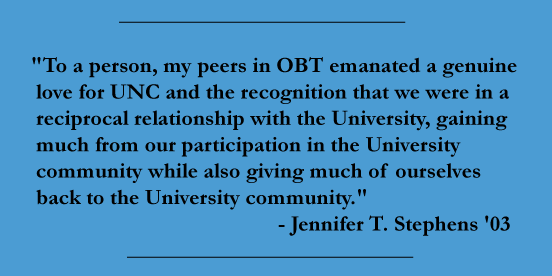
When Kat Butler Jackson '07 became the group's advisor after graduation in 2007, the Order of the Bell Tower did a lot of soul searching about its mission and some changes and enhancements began to take place. She had served as an OBT member all four years of college, literally stumbling onto the group as a freshman when she noticed a OBT flyer stuck to her foot after running out of the rain and into Ehringhaus South dorm (now Koury). She was happy with the success of OBT while she was a student and she wasn't particularly looking to shake things up. But there was a movement afoot on campus to look at the future of student groups on campus.
"Carolina had so many student organizations," Jackson said. "The ambassadors to the admissions office were doing an overhaul of what they were doing. So we steered the group into a discussion about what really is our mission." The Order of the Bell Tower had the tagline of "connecting past, present and future Tar Heels" but OBT members sat down to really talk about what exactly that meant going forward. They determined, despite all the projects, that there was not enough mission-related work going on.
"The students went through a great, thoughtful process and they decided they wanted to put a flag in the ground and stake their claim as the tradition keepers of the University," Jackson said, adding that they viewed it as an enhancement to what they were doing rather than an entirely new direction for the Order of the Bell Tower.
During the 2007-2008 school year, members of the OBT took pictures and wrote short pieces about Carolina 's history and traditions. During the 2008-2009 year, OBT members picked 82 traditions to include in the book. After a lot of work, in 2009 they came out with the first True Blue Traditions Book, 2,000 copies of which where distributed free to first-year and transfer students who attended Convocation. Others could purchase the book for $10 if they were GAA members or $15 for everyone else.
By this time, social media had so much influence on daily life that students weren't printing out pictures to capture what they were doing. This book had many pictures but it was also a way to document or mark off the student's involvement with various traditions. It was promoted as "a ready-made scrapbook." There were blank spaces where students could include a printed picture, ticket stub or other souvenir to remember having taken part in the tradition. "It was a beautiful piece that was a way to educate and encourage all Carolina students to engage in these quintessential Carolina moments before they graduate," Jackson said.
The book also detailed early Tar Heel traditions and taught the reader the alma mater and various fight songs and cheers associated with the University. Katie Littlefield '09, the chair of the committee, as a senior recognized how fast the college years go by. "You only have a few years at Carolina as a student," she wrote in the introduction. "Time is already flying by. I hope this book will help you prioritize and take advantage of all that can be done in your remaining semesters in this place we know as Chapel Thrill."
OBT president Jacob Byrne '10 encouraged students to promote and share the traditions with others on campus. "Participating in these activities connects you with Carolina students of all ages and will bring you closer to the people who are around you as you complete these traditions," he wrote. "Whether it is a basketball game or enjoying University Day under the Davie Poplar, make it a goal always to be willing to go to new events and to share these memories with your fellow students."
In 2011, The Daily Tar Heel published an updated "bucket list" of 100 items in conjunction with the Order of the Bell Tower which included everything from drinking from the Old Well on the first day of classes and swimming laps at the Bowman Gray pool to visiting Gimghoul Castle at night and climbing the Bell Tower on Senior Day.
You won't see suggestions for freshmen to wear beanies to class until after the UNC-Duke football game nor will you see recommendations to go on a panty raid at a girl's dorm. "The Order of the Bell Tower should be known most for using traditions as a way to welcome everyone – prospective students, incoming first years, current students, visitors, and alumni – to Carolina," said South Moore '15, who served as OBT president. "Traditions are tricky – they are, by definition, exclusive. If something is a Carolina tradition, then only those associated with Carolina can take part. That it is why it is so important that OBT make anyone who steps foot on our campus feel included in our traditions."
The traditions are ever evolving. Moore said that for a good part of its history, Carolina exclusively served males, mostly white males. "Our traditions, especially our longest held traditions, will reflect this," he said, adding that UNC now welcomes people of all races, genders, ideologies and economic backgrounds. "The Order of the Bell Tower's biggest obstacle will be recognizing and celebrating the traditions of diverse groups."
The Order of the Bell Tower, even before the production of the traditions book, took pride in maintaining traditions of the past while also being innovative and forward-thinking, taking great pride in being inclusive of older alumni and their traditions while connecting them to current and even future students and their newer traditions.
Some potential new traditions like "First Year Photo" didn't catch on. In 2011, the idea was to get as many freshmen as possible together for a group picture at Kenan Stadium. The OBT had learned about a similar project at one of the CASE ASAP conferences and it seemed to get a lot of publicity. "That was an undertaking," said Jackson, who was in her last year as OBT adviser. "That was definitely wild and probably not the highest participation rate. Getting people into Kenan all dressed in Carolina blue and pictured in one frame was quite a feat. But it was a great idea."
Other newer traditions such as the True Blue Trek seem to have caught on... finally. The project has become OBT's signature Homecoming week event. The True Blue Trek is a scavenger hunt intended to educate students about UNC's history. It started as a Twitter contest where the OBT would tweet out clues about the location of a medallion each day for a week. The person who found it first received a prize. It was difficult to know how many people took part but when the same person won it three years in a row, the OBT came to the conclusion that not many people were playing. In 2012, the OBT made the scavenger hunt a bit more involved and they gave it a higher profile by displaying the clues in the windows of Student Stores. This still didn't require any interaction with the OBT so it was difficult to judge the success. In 2013, the OBT sent members to a new location each day and participants had to check in with them at every stop using a QR code on their tech device. This made the event more involved and interactive.
However, starting in 2014, the True Blue Trek has become more like the Carolina version of the "Amazing Race" TV show. Taking it off Twitter and making it more of an old-fashioned scavenger hunt has proven successful. Teams of two start out at the Alumni Center for the one-night scavenger hunt. Students receive a clue that takes them to another location on campus where they perform a traditions-based task, such as singing the Alma Mater, before they can receive their next clue. It ends with a race to the top of the Bell Tower.
Moore, who was president of the OBT for the first new version of the True Blue Trek, said the OBT picked lesser known historical places and traditions to highlight. "For example, one stop on the Trek was the Caldwell monument and when students got there, they had to read about who Joseph Caldwell was," he said. "Very few of them knew that he was our first president." While it's impossible to know how many more students participate in this more recent version of the True Blue Trek, Moore believes there is more interest now. "A lot of people wanted to participate in this scavenger hunt," Moore said. "And those who did participate took it seriously. Students were literally sprinting from one location to the next – they got very competitive. It was just more exciting." Prizes have included a GoPro camera and gift cards to Top of the Hill restaurant.
Students who read the traditions book certainly have an advantage, especially in completing the traditions task at each stop. The fourth edition of "True Blue: Carolina's Tradition Book," with updated traditions, was published in 2015 as a 92-page, 8" by 8" keepsake complete with a silver foil imprint on the front and back covers. The new book is $15 for members of the General Alumni Association or the Student Alumni Association and $25 for all others. The book is free to first-year students at selected events.
Another lively event that has become a tradition in recent years is the Order of the Bell Tower's celebration of Hinton James Day each Feb. 12. With a full day of activities, the OBT commemorates the life of Carolina 's first student who arrived in Chapel Hill on Feb. 12, 1795 after walking 170 miles from Wilmington. Every year an OBT member dresses up as Hinton James in a time-period costume borrowed from the Drama Department. Traditionally, freshman accompany him on an early morning walk from Hinton James Dorm to the main campus. With recording devices Hinton James could have only imagined documenting the day, in 2010, OBT member Stephen Dougherty approached the Pit area in costume saying, "I am Hinton James. I am here upon behalf of the Order of the Bell Tower ... There is a significant tradition with the Order of the Bell Tower and I proudly represent them today."
In 2011, there were two OBT members playing Hinton James. Lex Janes, in character as Hinton James, brought a light-hearted tone to the day as he told fellow students on campus, "I wasn't really feeling Harvard or Princeton. Plus, it would have been a much more difficult walk." Joey DeRusso '13, who served as the other Hinton James, said recently that the OBT "ensures that the University's history and traditions remain intact because OBT serves as its stewards," adding that it's quite a legacy.
On Hinton James day, members of the Order of the Bell Tower deliver a cake to those living at the Hinton James dorm, and then head to main campus where they hand out suckers and ask students trivia questions related to Hinton James and the University's history. The person playing Hinton James engages students in conversation and even challenges them to games of cornhole. Most recent years OBT has hosted a Hinton James rare artifacts exhibit and lecture in conjunction with Wilson Library. In 2014, Hinton James Day events were affected by snow. In fact, the Hinton James character was to make an appearance at the Duke at UNC basketball game on the night of Feb. 12 but the game was postponed due to bad weather.
While Hinton James Day might have been the most fun event while Jackson was the OBT adviser and while she might be the most proud of the advent of the True Blue traditions book, the most meaningful tradition the OBT is involved in may be the official ring ceremony. Decades and decades earlier there may have been ring ceremonies on campus but for as long as anyone can remember, the company that produces the rings simply mailed the ring to the student. "We thought, what's so special about that," Jackson said. "The Alumni Association and OBT thought it through and we said let's do a ceremony at the Carolina Club."
In 2010, and each year thereafter, the GAA and the OBT has sent invitations to all those who purchase rings. Students and their families dress up for the ceremony where the OBT calls out the names and presents the rings. "We found this is much more intimate than graduation and we found that a lot of first-generation college kids would bring tons of family members because it was such a huge accomplishment. It was neat to see that as a really cool, unexpected benefit." Those who opt not to go the ceremony have to wait until after the ceremony in order to receive their ring. "I would say 90 percent of those who ordered rings would come to the ceremony," Jackson said. "The first year all three alumni halls were filled and it holds up to about 500 people." Freddie Kiger '74, a well-known historian, spoke beautiful words, Jackson said, about the symbols on the ring and what they mean.
Before the GAA and the OBT got involved with class rings, any number of combinations of designs and stones could be considered a Carolina ring. But they worked with Balfour, the ring company, to whittle down the collection to four or five choices that center around a Carolina Blue stone or onyx with the fam`ous interlocking NC on them. "Now you can go anywhere in the world and recognize that the person went to Carolina by their ring," Jackson said. "As added sentimentality, the tradition is for the interlocking NC to face toward you before you graduate and face out after graduation."
Similarly, the OBT also helps with the GAA's Carolina Legacy Pinning Ceremony, where UNC alumni parents and grandparents of currently enrolled students come to the George Watts Hill Alumni Center to welcome their child or grandchild into the Carolina family. After the ceremony, which includes a keynote address from a prominent alumni, there are refreshments and a family portrait taken as a keepsake gift.
Projects like the Legacy Pinning Ceremony, the Official Ring Ceremony, Shadow Day, the True Blue traditions book and, yes, the tried and true Chancellors' Box hosting for football games led to the Order of the Bell Tower winning a national outstanding organization award in 2012 from CASE ASAP. The Order of the Bell Tower originally was a member of the national Student Alumni Association/ Student Foundation Network which became a part of The Counsel for Advancement and Support of Education (CASE) in 1992 and eventually changed its name to CASE ASAP (Affiliated Student Advancement Programs). OBT had won several awards over the years but most were regional or district awards.
"That was one of my proudest moments," said Jackson, who was adviser at the time. "Winning the outstanding organization at the CASE conference going up against powerhouses like the University of Florida and Mississippi was incredible. We had previously won one but it was back in the mid-1990s so it was a big deal." In fact, that same year the Order of the Bell Tower won four district awards, the most the OBT has ever won in one year.
Olivia Hammill '12, president of the OBT, won the Southeast District Outstanding Student Leader award in 2012. When she thinks back about her time in the Order of the Bell Tower, it's not the award that sticks out in her mind though. "Right before I graduated, Kat (Butler Jackson) gave me a book with letters from OBT members I had worked with throughout the years, reminiscing about our experiences and everything we had done together," Hammill said. "To this day, that is the best and most cherished gift I've ever received and perfectly encapsulates everything OBT meant to me then and still means to me today."
Still, the award was well deserved, Jackson said. "Olivia did a good job showing how important it is to maintain your roots but to also do something exciting and new," Jackson said. "It took a lot of work and there were a lot of changes that year, and change is not easy."
That proved to be true in 2013 when C. Hawkins '00 took over as the adviser to the Order of the Bell Tower and saw a need to reduce the number of members of the OBT. Over the years, he said, the GAA had taken on more and more responsibility for running the projects in part because there was more staff to do so and in part because students were increasingly pulled in different directions. For instance, in the 1980s there were a little more than 100 student organizations on campus and today there are more than 700. In the '80s, the GAA supported one student group and that was the Order of the Bell Tower. Today the GAA sponsors the Student Alumni Association, the Senior Class, the Homecoming Committee, the Loreleis and the Clef Hangers.
At times, due to manpower needs, the OBT has had as many as 80 members and as few as 40. When Hawkins took over there were close to 40 but he said 15 to 20 were doing all the work. With projects changing, ceasing to exist or being taken on by other groups or GAA staff, he said he felt there were some people in the group going along for the ride because it was a resume enhancer. "We needed to get the numbers down because there were so many people not doing anything," he said. "And actually fewer members would increase the prestige of the OBT. I told them 'you're going to have to work to wear the blue jacket, it doesn't come for free.'" His frank, dispassionate style and plans to dwindle the numbers, turned off most of the existing OBT members.
After Hawkins informed the members that all of them except the seniors had to reapply for membership in the OBT, 27 members wrote an 11-page letter to GAA President Doug Dibbert '70, asking him to make sure Hawkins serves as "adviser" rather than an "administrator" and that he exercise power only when it is clear that the student leadership is steering the organization towards certain disaster.
"There was an obvious shift of control away from students and towards adult employees of the GAA," said Scott Nelson '15. "This hurt many OBT members, as years of work put in as students (while juggling all of the other rigors of college life) was being quickly and inexplicably, it seemed, washed down the drain. We lost a lot of really good OBT members who couldn't stomach the changes."
Hawkins said that there was a lot of confusion and misinformation about the direction and that he could have communicated better. Eventually, most of the hard feelings died down and some even took their names off the letter but the result was that OBT membership was capped at 25 and OBT's name would no longer be associated with things they weren't actually doing. "They can control OBT but they have to do the work," Hawkins said. "Staff was doing a lot of the work and allowing them to get the credit for it. That gives them a false sense of worth and it's not fair to the staff or to them."
Nelson said that his senior year "under this new management" was actually successful in many ways. "OBT did a lot of neat things and was involved on campus more than before," he said. "Yet, I still felt more removed from the organization." Brittany Reeves '14, who was OBT president when all the changes occurred, said the bad feelings came from misunderstandings about the direction of OBT as well as an entitlement mentality that some members felt. "My love and passion for OBT has never wavered even through the immense burden I had to take on," she said. "Older members of the organization had deep emotional ties to it, and I hope they have carried on this tradition in its current membership."
Hawkins, who hopes future staff and student leaders will have a better feel for the history of the group, said OBT, as always, is a work in progress. "I think they have, and they feel like they have, ownership now," he said adding that soon there would be no one left who was directly involved in all the painful changes. While he has moved on to a similar position at Northeastern University, most of the students involved have graduated. "It was something that needed to happen," he said. "OBT is on the right track with students who are really committed to it."
One change OBT has made recently that helps ensure that members are committed is recruiting members in the Spring rather than the Fall. When students arrive on campus for their first year in the Fall, they tend to apply for every organization they find and then see what sticks. By the Spring, most new students know better what interests them.
For those who were members of the Order of the Bell Tower from 2006 to 2012, the bigger controversy may be, "What happened to Obi?" After nearly seven years as the mascot for the Order of the Bell Tower, the Rameses-like hand puppet went missing and has never been heard from again. "It's always been a great mystery about where Obi ended up," Jackson said. "After Obi went missing, we went back to Johnny T-shirt and they didn't have it anymore. We went so far as going to the company and they weren't making it anymore. It was a sad day when the puppet went missing."
In an OBT newsletter on Sept. 12 of 2006, member GT Wharton '09 announced a new era of the "one-eyed demon pirate Rameses (feel free to rename)" complete with an eye patch. Wharton wrote, "This ram must stay with the specially selected member for two weeks and must accompany him or her at every major event that takes place in that time, be it a camping trip, funeral, basketball game or rollercoaster ride." The keeper of the puppet had to show video or photographic evidence that it was with them at different times during the day and not stuffed away.
Before one of the OBT member's mother sewed a second eye on what came to be named Obi, the puppet got in a bit of trouble. "He was found passed out at Kenan Stadium and was arrested later for pulling the Carmichael fire alarm at 4 a.m.," Wharton wrote in the newsletter. "After some stern rebuking, Rameses made it to a few soccer games and even met the abnormally large Rameses that haunts many sporting events (referring to the student-costumed mascot)."
The idea for the hand puppet came from one of the conferences after members thought about all the "swag" given out at those events and how other groups had mascots of some sort. "I know from my own experience that we learned a lot about how other universities keep traditions at the annual CASE ASAP meetings," Wharton said. "We got a lot of inspiration from those but we also created a lot of new programs from scratch." Though she started out as a fellow student before becoming his OBT adviser, Kat Butler, later Jackson, was a mentor and positive influence, he added.
Once Jackson was the OBT adviser, she took the mascot idea to a new level. It had gotten to the point that the same 12-15 OBT members were doing most all the work and she was looking for a way to engage more people. "Obi would go to a member at the meeting as a way to recognize someone who was doing great work for OBT and in the Carolina community," Jackson said. "It encouraged camaraderie and team building." At the next general body meeting, the keeper of Obi was expected to have a funny anecdote with a slideshow or video of what happened during the two-week period. "Obi went to a lot of 21st birthday parties and found every nook and cranny in Chapel Hill," Jackson said with a laugh. "It became a fun one-up policy to see who could do the most absurd thing or get back stage access to something with Obi." The puppet became quite the PR move as it helped get the Order of the Bell Tower 's name out there.
In the last few years, OBT has also become closer to its namesake - the Morehead-Patterson Bell Tower itself. The Order of the Bell Tower shares the start of a new school with fellow students by illuminating the Bell Tower in blue and white. This Bell Tower Relighting ceremony precedes the first day of class. The OBT members themselves also use the Bell Tower as the backdrop to the induction of new members, who meet the current members at the base of the Bell Tower. Some serious words are spoken about the Bell Tower and how it represents their journey at Carolina with the floors of the Tower representing the years they are in school and how they won't fully appreciate what it means until they reach the top upon graduation.
"The one thing I remember the most about the Order of the Bell Tower is my initiation into it," said Sam Forlenza '16. "We were all dressed up and tricked (about what we were going to do). We had to attempt to walk in a single file line from the Union to the Bell Tower." The new OBT members got to walk up to the top of the Bell Tower. Forlenza called it "a very warming experience" as she got to celebrate with like-minded people who were or became great friends.
Once a year, the GAA hosts the Senior Bell Tower Climb where seniors get a chance to climb the Bell Tower to the top on a specified day during the last week of school before final exams. Senior Marshals, some of whom have been OBT members, assist with this event. The Bell Tower was pretty much off limits for many years but today the GAA, with assistance of OBT members, also sponsors walks to the top at Homecoming and other home football games. Colleen O'Neill Yanchulis '84 is a bit jealous about the greater access to the Bell Tower but she plans to make up for lost time. "I didn't know until I attended Homecoming 2014 that OBTers now get to sign the inside of the Bell Tower," she said. "I was assured that when I come back to climb this year, I should bring a Sharpie and add my signature!"
The Old Well is still the most iconic symbol on Carolina's campus but for members of the OBT the Bell Tower has surpassed it. "(Recently) I was running in the park with my son and I received a text message with a picture of the Bell Tower from a neighbor whom I haven't seen or spoken to in a very long time," said Laura Pierro '94. "The caption read, 'I'm lost and don't know where I am.' My response, immediately was that there was good news and there was bad news. The bad news was that you've died, but the good news is that you wound up in heaven, because as I've repeatedly said 'Carolina is a little slice of heaven, which is why God make the sky Carolina blue.'"
From the time an OBT member took Pierro on a tour of Carolina and she herself became a member of OBT, she said she understood what was meant by, "if I were cut, I'd bleed Carolina Blue." She said the Order of the Bell Tower represented the spirit and essence of what it means to be a Tar Heel. "Still today being a Tar Heel is such an integral part of my fabric," she said.
Some estimate that those who have been members of the Order of the Bell Tower are more than twice as likely to be a lifetime member of UNC General Alumni Association than those who are active in other groups on campus. Regardless, Laurie Norman '83, who has remained close to the OBT from the days of being a member and an adviser, said that most members of the Order of the Bell Tower leave with an appreciation for Carolina's traditions and what the GAA has provided and can provide.
"It's nice to think that many OBT members leave every year knowing about the alumni association - knowing what they offer, knowing that they are the group that caters to them and cares about them," Norman said. "Regardless of how much an alumnus may be able to contribute to the University, the General Alumni Association welcomes every alumnus to join and participate in the life of this great place."
Tanea Pettis '95, who was the OBT adviser for seven years, said that the GAA's relationship with the Order of the Bell Tower is a perfect example of how engaging students while they are enrolled leads to a stronger Carolina. "OBT alumni have continued their strong leadership well after their time as students," Pettis said. "They are members of the GAA board of directors, UNC board of trustees and board of visitors, major donors, faculty and staff, leaders in business and the list is endless."
That was certainly the idea that Dr. Dewey Dorsett '47 had when he helped come up with the idea. "I'm so glad it materialized that way," he said. "And I'm certainly glad that the Order of the Bell Tower has had such a long life."
In 1980, the UNC General Alumni Association made a good investment in helping form the Order of the Bell Tower. But even those who started the group couldn't have known the effect it would have on the GAA, on the campus community, on the students and alumni, and on the OBT members themselves.
Yes, the Order of the Bell Tower is a student-alumni service organization that honors the memories and upholds the traditions of the University well into the future. But it has turned out to be so much more to so many.